What Is a Trading Pair
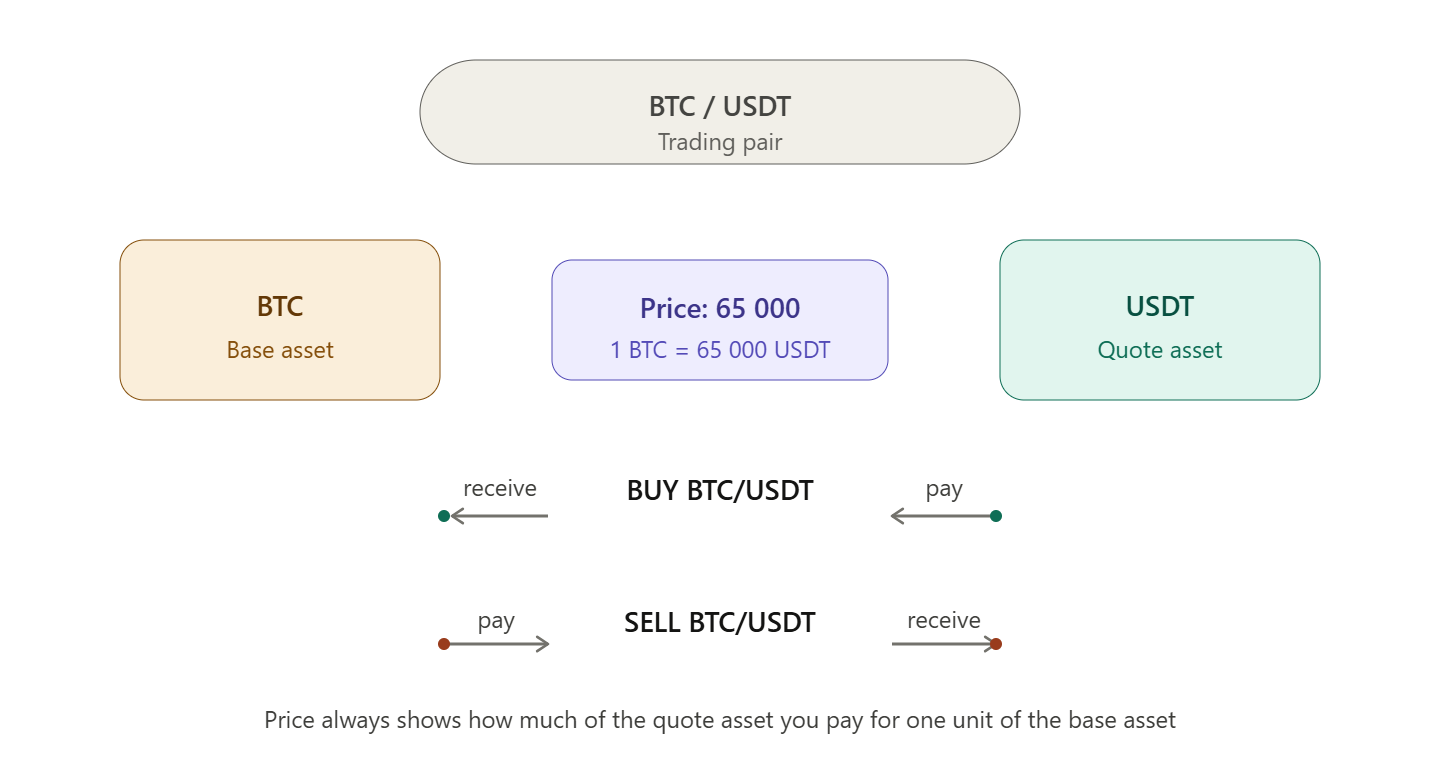
A trading pair is a combination of two assets that can be exchanged for one another on an exchange. A pair such as BTC/USDT means that Bitcoin is bought and sold against Tether (USDT). The asset on the left is called the base asset, while the asset on the right is the quote asset. The price of the pair always indicates how many units of the quote asset are required to purchase one unit of the base asset.
Understanding the structure of a trading pair is the starting point for trading on any exchange. Every trade is executed through a trading pair, so knowing exactly which asset you are buying and which asset you are paying with is essential to placing orders correctly.
Structure of a Trading Pair
BTC / USDT
 ↑      ↑
Base Quote| Element | Name | Description |
|---|---|---|
| BTC | Base Asset | The asset being bought or sold |
| USDT | Quote Asset | The asset used to pay for the trade |
| Pair Price | — | The amount of USDT required to buy 1 BTC |
Example: If the price of BTC/USDT is 65,000, then 1 BTC costs 65,000 USDT.
- Buy BTC/USDT → Spend USDT and receive BTC.
- Sell BTC/USDT → Spend BTC and receive USDT.
Types of Quote Assets
Cryptocurrency exchanges commonly use several categories of quote assets.
Stablecoins
The most common type of quote asset. The price is denominated in a stablecoin pegged to the U.S. dollar, making trading intuitive because the asset's value is displayed directly in a dollar-equivalent currency.
Examples: BTC/USDT, ETH/USDC, SOL/FDUSD
Bitcoin (BTC)
Historically, this was the first type of cryptocurrency trading pair. It allows traders to exchange altcoins directly for Bitcoin, which is useful when accumulating BTC or when no stablecoins are available in the account.
Examples: ETH/BTC, SOL/BTC, BNB/BTC
Ethereum (ETH)
Pairs quoted in ETH are common within the DeFi ecosystem and on exchanges that support a wide range of Ethereum-based tokens.
Examples: UNI/ETH, LINK/ETH, AAVE/ETH
Fiat Currencies
Exchanges that support fiat on-ramps allow users to trade cryptocurrencies directly against traditional currencies.
Examples: BTC/USD, ETH/EUR, BTC/RUB
Cross Pairs and Routing Through an Intermediate Asset
Not every asset is traded directly against every other asset. When a direct trading pair is unavailable, exchanges or traders use a cross rate, routing the trade through an intermediate asset.
Example: You want to buy LINK using BTC, but the LINK/BTC pair is unavailable.
The trade can be completed through a cross pair:
- BTC → USDT (sell BTC for USDT)
- USDT → LINK (buy LINK with USDT)
The cross rate is calculated automatically from the available pairs:
LINK/BTC = LINK/USDT ÷ BTC/USDT
ℹ️ Liquidity Aggregators
Some exchanges and DEX aggregators (such as Jupiter on Solana) automatically route trades through multiple intermediate pairs to achieve the best possible execution price. Users only see the final swap result.
How to Read a Trading Pair Price
The price of a trading pair always represents the value of one unit of the base asset expressed in the quote asset.
| Pair | Price | Interpretation |
|---|---|---|
| BTC/USDT | 65,000 | 1 BTC = 65,000 USDT |
| ETH/BTC | 0.048 | 1 ETH = 0.048 BTC |
| SOL/USDT | 145 | 1 SOL = 145 USDT |
| BNB/ETH | 0.21 | 1 BNB = 0.21 ETH |
Inverting a Trading Pair
It is important to understand that BTC/USDT and USDT/BTC are different trading pairs with different price interpretations.
- BTC/USDT = 65,000 → 1 BTC costs 65,000 USDT.
- USDT/BTC = 0.0000154 → 1 USDT is worth 0.0000154 BTC.
On most exchanges, trading pairs follow standardized conventions. For example, USDT is almost always used as the quote asset, not the base asset.
The Bid-Ask Spread
The spread is the difference between the best bid and ask prices in a trading pair. It is an important factor in trading costs.
| Metric | Value | Explanation |
|---|---|---|
| Ask | $65,020 | The price at which you buy the base asset |
| Bid | $64,980 | The price at which you sell the base asset |
| Spread | $40 | The difference between the best bid and ask prices |
| Spread (%) | 0.06% | Relative spread expressed as a percentage |
💡 Helpful Tip
When choosing a trading pair, always check the spread. Popular pairs such as BTC/USDT and ETH/USDT typically have spreads below 0.1%. Low-liquidity pairs may have spreads of 1–3% or more, significantly increasing the cost of each trade.
How the Quote Asset Affects P&L
The quote asset determines the currency in which your profit or loss is measured.
Example 1: BTC/USDT
- Bought 1 BTC at $60,000.
- Sold 1 BTC at $65,000.
- Profit: +5,000 USDT.
Example 2: ETH/BTC
- Bought 10 ETH at 0.045 BTC each (spent 0.45 BTC).
- Sold 10 ETH at 0.050 BTC each (received 0.50 BTC).
- Profit: +0.05 BTC.
⚠️ Important
In the ETH/BTC trading pair, your P&L is denominated in BTC, not in U.S. dollars. If the price of Bitcoin rises during your trade, your profit in USD will be higher than expected. If Bitcoin falls, your USD profit will be lower. This creates an additional layer of risk when trading crypto-to-crypto pairs compared to pairs quoted in stablecoins.
How to Choose a Trading Pair
When selecting a trading pair, consider the following factors:
| Criterion | What to Look For |
|---|---|
| Liquidity | Daily trading volume and order book depth |
| Spread | Narrower spreads reduce hidden trading costs |
| Quote Asset | Determines the currency in which P&L is calculated |
| Pair Volatility | Crypto-to-crypto pairs are often more volatile |
| Availability | Ensure the pair is supported by your chosen exchange |