What Is an Order Book
An order book is an electronic list of all active buy and sell orders for a specific asset on an exchange, organized by price. It displays the market's visible supply and demand in real time—showing who wants to buy or sell, at what price, and in what quantity.
The order book is the primary price discovery mechanism on a centralized exchange. It is where buyers and sellers meet, the current market price is established, and trades are executed. Understanding how to read an order book gives traders insight into the market's short-term supply and demand dynamics and helps them make more informed trading decisions.
Order Book Structure
An order book consists of two sides separated by the current market price.
| Side | Name | Placed By | Traditional Color |
|---|---|---|---|
| Upper | Ask (Offers) | Sellers | Red |
| Lower | Bid | Buyers | Green |
An ask is the lowest price at which a seller is willing to sell an asset. The lowest ask is known as the best ask.
A bid is the highest price at which a buyer is willing to purchase an asset. The highest bid is known as the best bid.
The spread is the difference between the best ask and the best bid. It represents the minimum cost of executing an immediate trade.
Best Ask:  $65,020   ← You can buy immediately at this price
──────────────────── Spread = $40
Best Bid:  $64,980   ← You can sell immediately at this price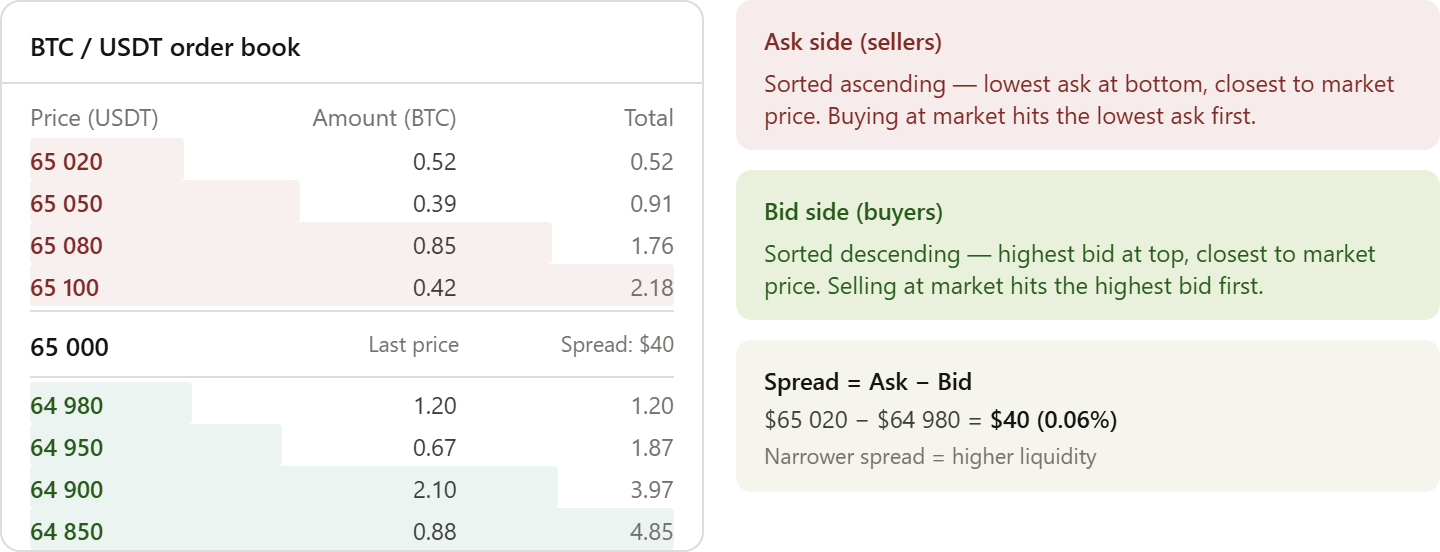
How to Read an Order Book
A standard order book contains three columns:
| Column | Description |
|---|---|
| Price | The price level of the order |
| Amount (Size) | The quantity of the asset available at that price |
| Total | The cumulative volume from the best price to the current price level |
Example: BTC/USDT Order Book
Ask (Sell Side) — Red Side:
| Price (USDT) | Amount (BTC) | Total (BTC) |
|---|---|---|
| 65,100 | 0.42 | 2.18 |
| 65,080 | 0.85 | 1.76 |
| 65,050 | 0.39 | 0.91 |
| 65,020 | 0.52 | 0.52 |
Bid (Buy Side) — Green Side:
| Price (USDT) | Amount (BTC) | Total (BTC) |
|---|---|---|
| 64,980 | 1.20 | 1.20 |
| 64,950 | 0.67 | 1.87 |
| 64,900 | 2.10 | 3.97 |
| 64,850 | 0.88 | 4.85 |
Spread: $65,020 − $64,980 = $40 (≈ 0.06%)
How Orders Are Executed
Matching
An exchange's matching engine continuously matches incoming orders with orders on the opposite side of the order book. A trade is executed when a buyer's price matches or exceeds a seller's asking price.
Execution priority:
- Price — orders with the best price are executed first.
- Time — if multiple orders have the same price, the earliest order is executed first (FIFO – First In, First Out).
Market Order vs Limit Order
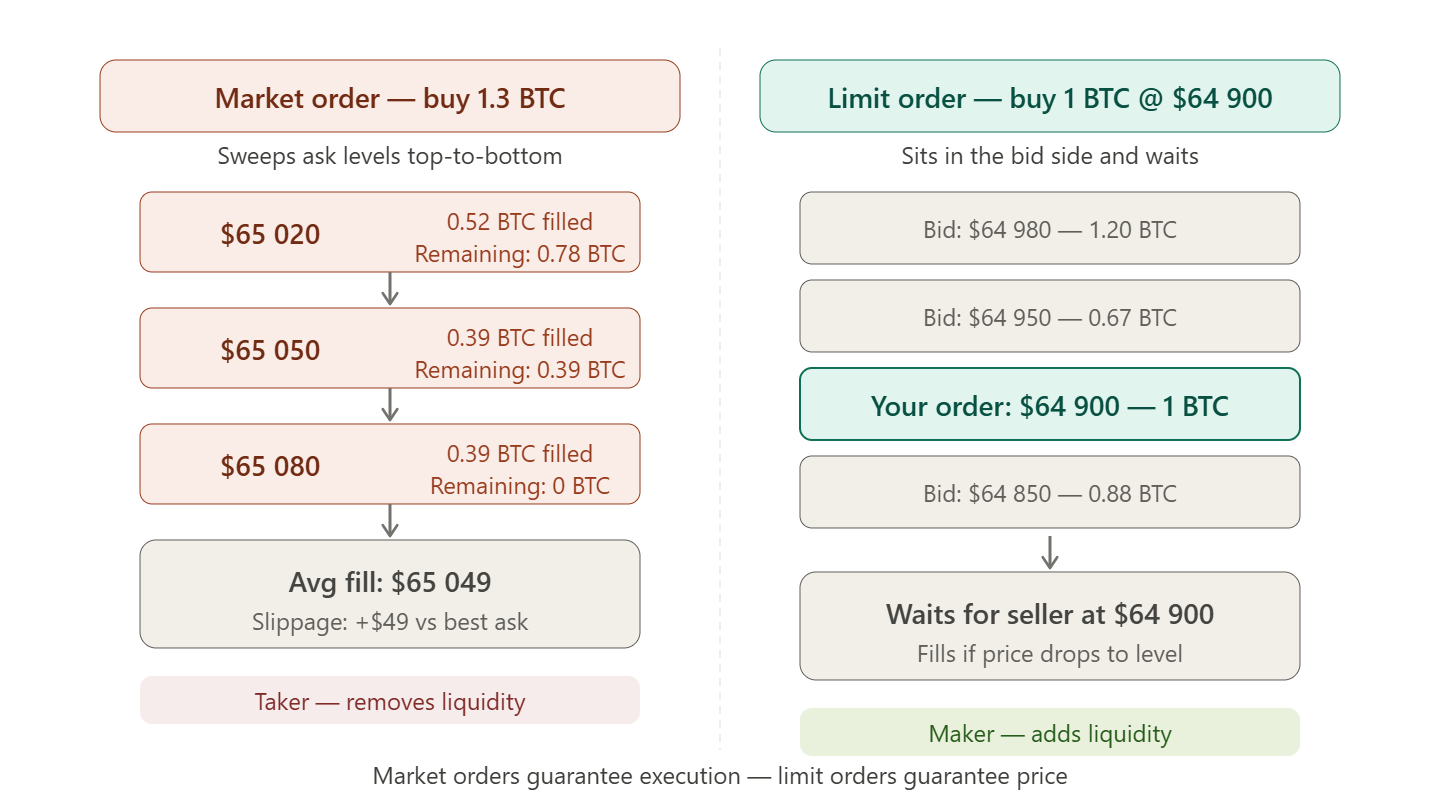
Market Order (Taker): A market order is executed immediately against the best available prices in the order book. For example, if you buy 2 BTC with a market order, your order will consume multiple ask levels—first 0.52 BTC at $65,020, then 0.39 BTC at $65,050, and so on. As a result, your average execution price will be higher than the best ask.
Limit Order (Maker): A limit order is placed into the order book and waits to be executed. For example, if you place a limit order to buy 1 BTC at $64,900, your order will appear on the bid side of the order book at that price and will remain there until a seller is willing to sell at $64,900.
Market Depth
Market depth is the total volume of buy and sell orders available at different price levels in the order book. It is commonly visualized using a depth chart, which displays two curves extending from the current market price—the bid curve on the left (green) and the ask curve on the right (red).
What Market Depth Shows
- Steep curves (volume increases rapidly near the current price) indicate high liquidity close to the market price.
- Gradual curves indicate limited liquidity near the current price and a greater likelihood of slippage for large orders.
- Order walls are sharp vertical steps on the chart that represent large orders at specific price levels. They may temporarily act as support or resistance.
Buying and Selling Pressure
The balance between bid and ask volume provides insight into short-term market pressure.
| Situation | Interpretation |
|---|---|
| Bid >> Ask | Buying demand dominates; upward price pressure is likely. |
| Ask >> Bid | Selling pressure dominates; downward price pressure is likely. |
| Bid ≈ Ask | Market is balanced; sideways price movement is more likely. |
⚠️ Important Limitation
The order book displays only visible orders. Large market participants often use iceberg orders, where only a small portion of the total order is visible while the remaining volume stays hidden and is revealed gradually as the visible portion is filled. As a result, the visible order book does not represent the market's complete trading interest.
Order Book Levels (Level 2 Data)
What traders commonly call the order book or market depth is formally known as Level 2 market data. Unlike Level 1, which only shows the best bid and ask prices, Level 2 displays multiple price levels and their associated order volumes.
| Level | Contents | Availability |
|---|---|---|
| Level 1 | Best bid, best ask, last traded price | Widely available, usually free |
| Level 2 | Full order book with multiple price levels and volumes | Available on most exchanges |
| Level 3 | Individual orders with unique identifiers | Rare; primarily used for high-frequency trading (HFT) |
On Cifra X, the Level 2 order book is available to all users within the trading interface.
Reading the Order Book in Practice
Support and Resistance in the Order Book
Large orders in the order book can temporarily act as support or resistance levels.
- Bid wall — a large buy order at a specific price level. As the price declines, it may temporarily stop the downward movement because sellers must absorb the entire order before the price can move lower.
- Ask wall — a large sell order at a specific price level. It can slow or temporarily halt upward price movement.
🚨 Fake Order Walls
Large orders can be intentionally placed and then canceled before execution. This practice is known as spoofing. It creates the illusion of strong buying or selling interest in an attempt to influence other traders' decisions. Spoofing is considered a form of market manipulation. Avoid making trading decisions based solely on large visible orders in the order book.
Estimating Slippage Before Placing an Order
Before submitting a large market order, it is useful to estimate potential slippage using the order book.
- Open the order book for the desired trading pair on Cifra X.
- Review the Total column on the ask side (when buying).
- Find the price level where the cumulative volume matches the size of your order.
- The difference between that price and the best ask is your estimated slippage.
💡 Helpful Tip
If your order size exceeds 1% of the visible liquidity across the nearest 5–10 price levels, consider splitting it into multiple limit orders or waiting for additional liquidity to enter the market. This is particularly important when trading low-liquidity assets.
Trade Tape (Time & Sales)
Next to the order book, you will typically find the trade tape (also called Time & Sales), which displays all executed trades in real time.
The trade tape shows:
- Execution price.
- Trade size.
- Trade direction (buy or sell).
- Execution time.
The trade tape complements the order book. The order book shows traders' intentions, while the trade tape shows actual completed transactions. A large number of high-volume trades executed at the ask price generally indicates aggressive buying pressure.
Order Books on Centralized vs Decentralized Exchanges
| Feature | CEX (Cifra X) | DEX (Uniswap) |
|---|---|---|
| Trading Model | Order book | AMM liquidity pool |
| Price Discovery | Order matching | Mathematical pricing formula |
| Transparency | Visible order book | On-chain liquidity pool state |
| Slippage | Depends on order book depth | Depends on pool size |
| Market Manipulation | Spoofing is possible | Sandwich attacks are possible |
| Execution Speed | Milliseconds | Blockchain confirmation time (≈12 seconds on Ethereum) |
Some decentralized exchanges, such as dYdX and Vertex, use a hybrid architecture with an off-chain order book and on-chain settlement.