What Are TP/SL Orders
Take Profit (TP) and Stop Loss (SL) are conditional orders that are executed automatically when the market price reaches a predefined level. TP locks in profits when the price moves in your favor, while SL limits losses when the market moves against your position.
Together, TP and SL create an automated trade management system: the trader sets the parameters in advance and does not need to monitor the market continuously—the orders will be executed automatically when the specified conditions are met. They are among the most fundamental risk management tools in trading.
How TP and SL Work
Take Profit (Locking in Profit)
A Take Profit order automatically closes a position when the target profit level is reached. Once the market price reaches the TP level, the position is closed and the profit is realized.
Example for a long position:
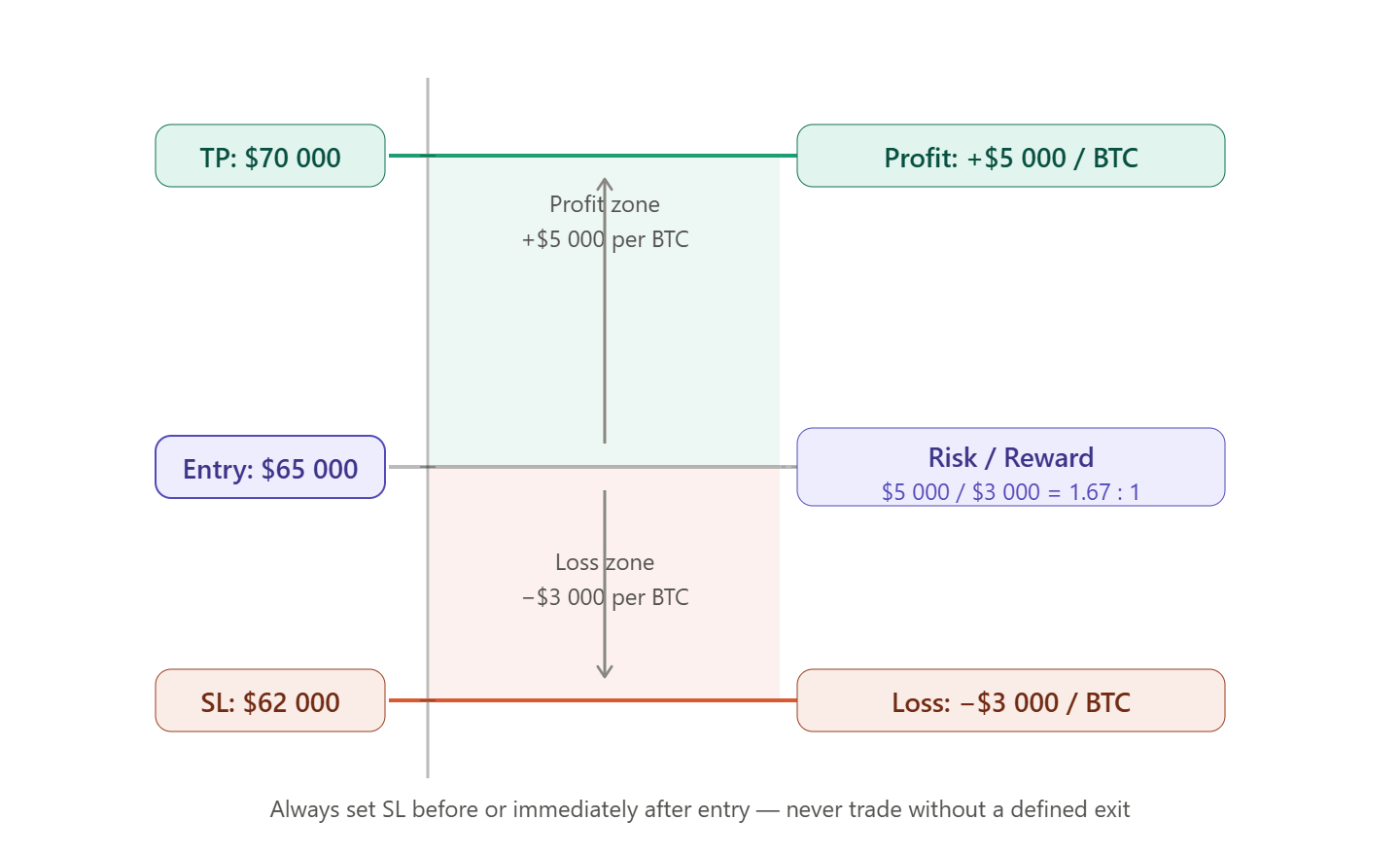
- You buy BTC at $65,000
- You set a TP at $70,000
- If the price rises to $70,000 → the position is closed automatically, locking in a $5,000 profit
Example for a short position:
- You sell BTC at $65,000
- You set a TP at $60,000
- If the price falls to $60,000 → the position is closed automatically, locking in a $5,000 profit
Stop Loss (Limiting Losses)
A Stop Loss order automatically closes a position when the maximum acceptable loss level is reached. It helps protect your capital from significant losses.
Example for a long position:
- You buy BTC at $65,000
- You set an SL at $62,000
- If the price falls to $62,000 → the position is closed automatically, limiting the loss to $3,000
Example for a short position:
- You sell BTC at $65,000
- You set an SL at $68,000
- If the price rises to $68,000 → the position is closed automatically, limiting the loss to $3,000
TP/SL Execution Types
On Cifra X, TP and SL orders can be executed in two ways:
| Type | Trigger | Execution | Price Guarantee |
|---|---|---|---|
| Stop-Market | Price reaches the trigger level | Market order | No |
| Stop-Limit | Price reaches the trigger level | Limit order at the specified price | Yes |
Stop-Market TP/SL
Once the trigger price is reached, a market order is placed immediately. This guarantees execution but does not guarantee the exact execution price. During periods of high volatility, slippage may occur.
When to use:
- For Stop Loss: the preferred option, especially during highly volatile or emergency market conditions.
- For Take Profit: when securing profits is more important than achieving an exact execution price.
Stop-Limit TP/SL
Once the trigger price is reached, a limit order is placed in the order book at the specified execution price. This guarantees the execution price but does not guarantee that the order will be filled. If the market moves through the limit price too quickly, the order may remain unfilled.
When to use:
- For Take Profit: when locking in profit at a specific price is important.
- For Stop Loss: with caution, since a fast market move may prevent the order from being executed.
⚠️ Critical Information for Stop Loss
A Stop-Limit Stop Loss may fail to execute if the market gaps sharply through the specified price. For example, if you place an SL with a limit price of $62,000, but the market instantly drops from $64,000 to $60,000, your limit order will remain above the market price and may never be filled. For maximum downside protection, consider using a Stop-Market Stop Loss.
Calculating TP and SL Levels
Risk/Reward Ratio
A key principle of professional trading is maintaining a favorable Risk/Reward (R/R) ratio. The minimum recommended ratio is 1:2, meaning you aim to earn at least $2 for every $1 you risk.
R/R = (TP − Entry) / (Entry − SL)
Example:
- Entry: $65,000
- SL: $63,000 (risk $2,000)
- TP: $69,000 (potential profit $4,000)
- R/R = $4,000 / $2,000 = 2.0 ✅
| R/R | Evaluation |
|---|---|
| < 1.0 | Not recommended — risk exceeds potential reward |
| 1.0 – 1.5 | Minimum acceptable |
| 1.5 – 2.5 | Good ratio |
| > 2.5 | Excellent ratio |
Methods for Setting a Stop Loss
Support and Resistance Levels. Place the Stop Loss slightly below a key support level (for long positions). A break below this level often signals a trend reversal, making it reasonable to exit the trade.
ATR (Average True Range). Set the Stop Loss at 1.5–2× ATR from the entry price. This method accounts for the asset's current volatility and helps avoid being stopped out by normal price fluctuations.
Percentage Risk. Place the Stop Loss at a fixed percentage from the entry price—for example, no more than 2% below the entry. This is a simple approach but does not consider technical market structure.
Market Structure. Place the Stop Loss beyond the nearest significant swing low (for long positions) or swing high (for short positions), where a break would invalidate the current market structure.
Trailing Stop Loss
A Trailing Stop is a dynamic version of a Stop Loss that automatically follows the market price as it moves in your favor while remaining fixed if the market reverses.
How it works for a long position:
- The price rises → the trailing stop moves upward while maintaining the specified distance.
- The price reverses → the stop remains at its highest level and no longer moves downward.
- The price reaches the stop → the position is closed, locking in part of the profit.
| Parameter | Description |
|---|---|
| Trailing Distance | Distance between the stop and the current price (percentage or fixed amount) |
| Activation Price | Price at which the trailing stop becomes active |
💡 Helpful Tip
A trailing stop is particularly effective in trending markets because it allows profits to run while protecting against reversals. Setting the trailing distance too tight may result in frequent stop-outs during normal market pullbacks.
TP/SL in Practice: Complete Trade Example
Trade Setup:
- Asset: ETH/USDT
- Current price: $3,200
- Direction: Long (Buy)
- Position size: 5 ETH ($16,000)
- Maximum acceptable risk: 2% of account balance ($320 per trade)
Parameter Calculation:
| Parameter | Calculation | Value |
|---|---|---|
| Risk per trade | $320 | — |
| Stop Loss distance | $320 / 5 ETH | $64 per ETH |
| Stop Loss level | $3,200 − $64 | $3,136 |
| Target R/R | 1:2.5 | — |
| Take Profit distance | $64 × 2.5 | $160 per ETH |
| Take Profit level | $3,200 + $160 | $3,360 |
Final Trade Setup:
- Entry: $3,200
- Stop Loss: $3,136 (maximum loss −$320)
- Take Profit: $3,360 (potential profit +$800)
Step-by-Step Guide: Setting TP/SL on Cifra X
- Open the Trading section and select a trading pair.
- Go to the TP/SL tab in the order form.
- Choose the execution type — Market or Limit.
- Enter the trigger price at which the order should be activated.
- Specify the execution price at which you want to buy or sell.
- Enter the order size in the base asset or quote currency.
- Review the order details.
- Click Buy or Sell — the order will appear in the Open Orders section.
- Monitor the order status and cancel it if necessary.
⚠️ Risk Warning
TP and SL orders are valuable risk management tools, but they do not guarantee protection against losses. During market gaps, extreme volatility, or technical failures, a Stop-Market order may execute at a worse price than expected, while a Stop-Limit order may not execute at all. Do not rely solely on automated orders—monitor your positions regularly.