How to Recognize Scammers
The cryptocurrency industry attracts a disproportionately high number of scammers for several reasons: transactions are irreversible, the market is relatively young and largely unregulated, and users often make decisions under conditions of hype and FOMO. According to the FTC, in 2023 victims of cryptocurrency scams lost more than $4.6 billion — and these are only the reported cases.
Most fraudulent schemes exploit the same psychological mechanisms: greed, fear, trust in authority figures, and a sense of urgency. The ability to recognize these patterns is a key skill for safely participating in the crypto market.
Universal Signs of Fraud
Before looking at specific scam types, remember several warning signs that are common to almost all types of cryptocurrency fraud:
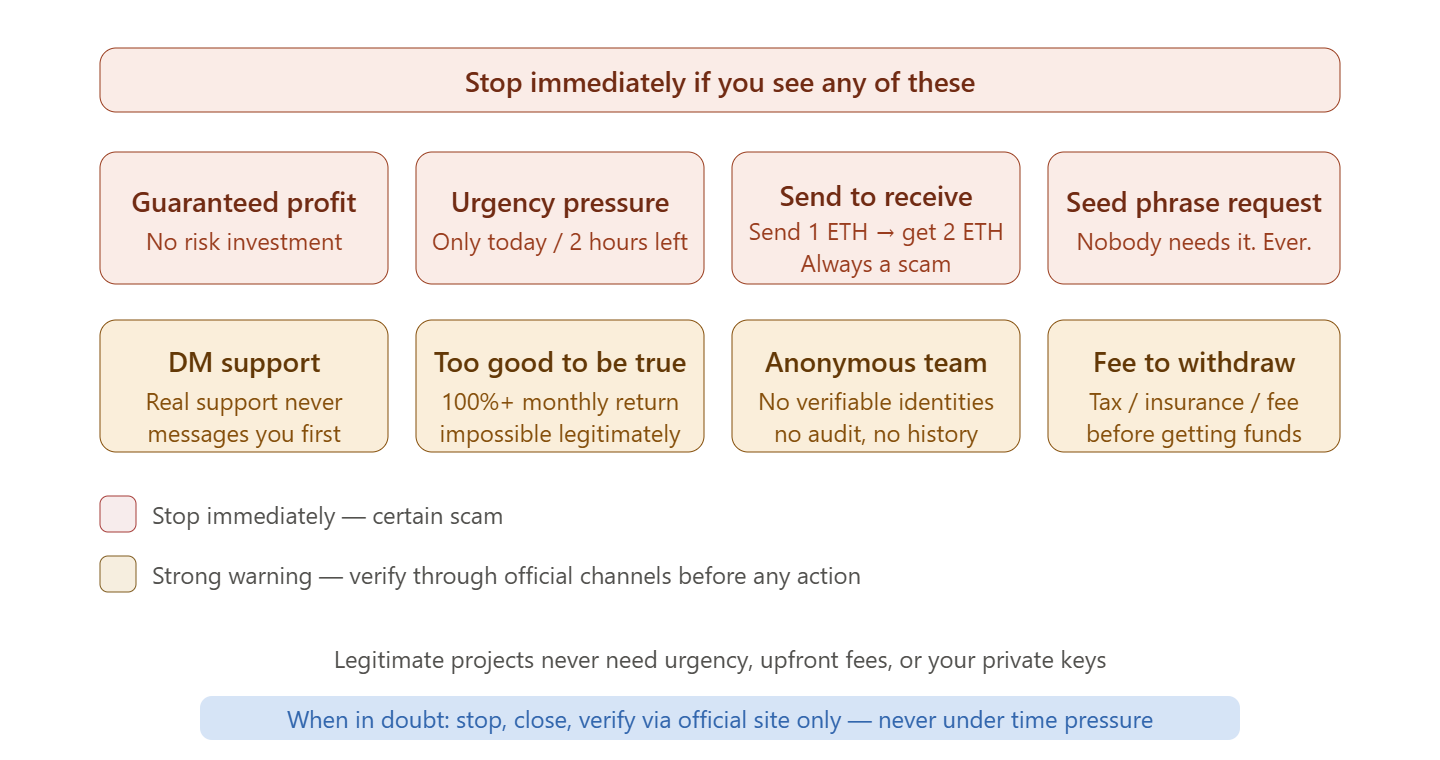
🚨 Stop communication immediately if
- You are promised guaranteed profits or returns with no risk
- You are pressured to make a decision quickly ("today only", "only 2 spots left")
- You are asked to send money first in order to receive money
- You are asked for your private key, seed phrase, or password
- Someone claims to be a representative of an exchange, Binance, Coinbase, or Cifra X in Telegram/Discord
- You are offered a "unique opportunity" that you supposedly discovered by chance
Main Types of Scams
1. Phishing
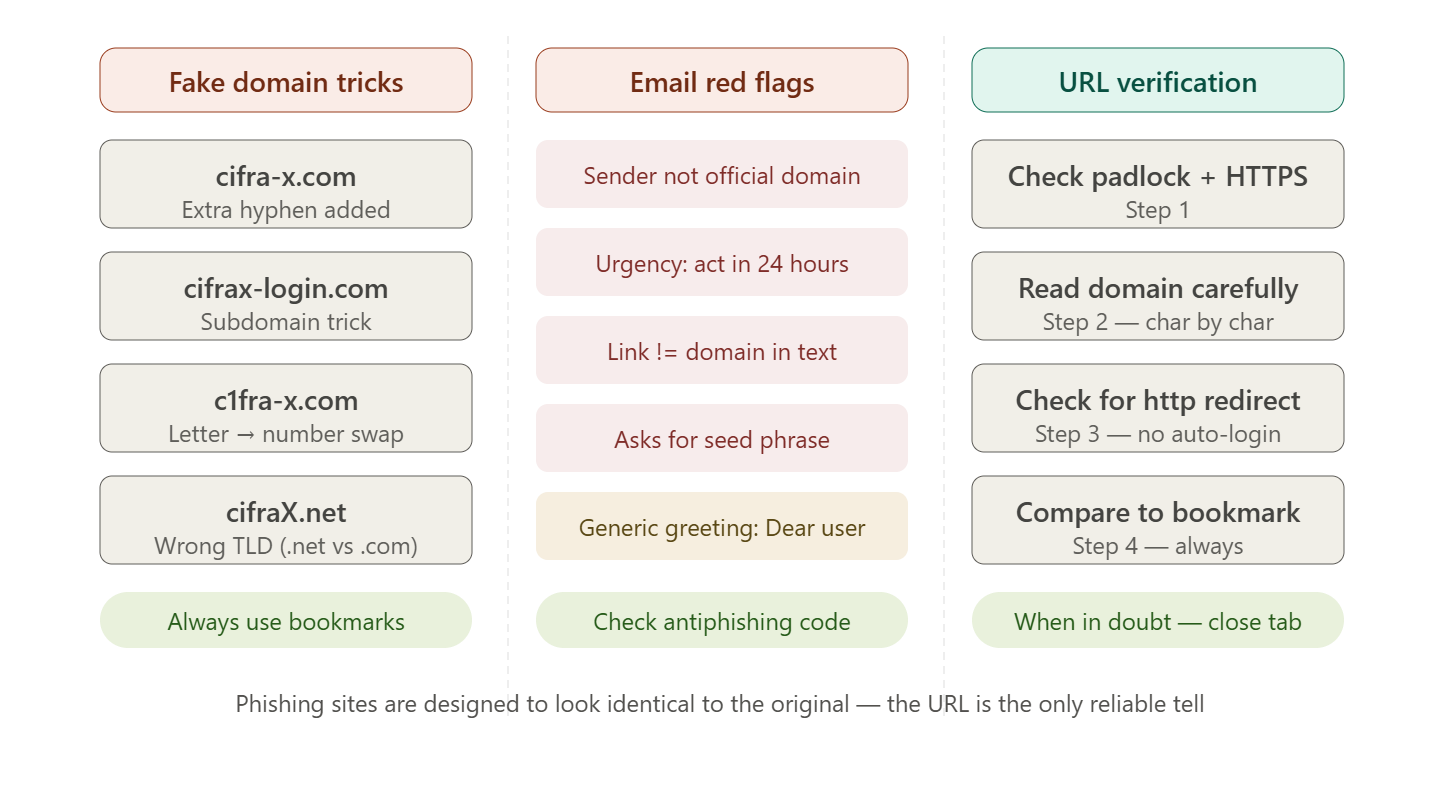
Creating fake websites, emails, and applications that imitate legitimate services in order to steal login credentials or seed phrases.
Examples:
- An email from "Cifra X" asking you to verify your account — while the sender domain is
cifra-x-security.cominstead of the official one - A copy of an exchange website with an address like
cifrax.netorcifraX.cominstead of the original - A fake application in the App Store / Google Play with a similar icon and name
- Search engine ads leading to a phishing website (the link is marked as "Sponsored" or "Ad")
How to protect yourself:
- Always check URLs manually, character by character
- Use bookmarks for frequently visited crypto websites
- Install applications only from official app stores using links from the official website
2. Fake Support
Scammers impersonate exchange support representatives in messengers and social networks.
Examples:
- You write a question in the official Telegram channel of an exchange — a "support employee" contacts you via direct message
- A Discord account with a similar name and exchange logo sends you a message
- "Security service" warns that your account has been hacked and you need to urgently "verify" your wallet
Signs:
- They contacted you first (real support teams do not send direct messages)
- They ask you to follow a link, enter information, or provide a 2FA code
- The account was recently created, has few followers, and uses a similar but not identical name
⚠️ Cifra X Rule
Cifra X employees will never contact you first via direct messages in Telegram, Discord, or other messengers. Official support is available only through the website chat and official email. Any message claiming to be from "support" in messengers is a scam.
3. "Pump and Dump" Scheme
A coordinated artificial increase in the price of an unknown token followed by a massive sell-off by the organizers.
Examples:
- A Telegram channel or Discord community with thousands of subscribers announces a "secret signal"
- They describe an unknown token with "revolutionary technology" and urge users to buy immediately
- The price rises sharply (organizers purchased the token beforehand at a low price)
- Once retail buyers enter the market, organizers sell, causing the price to collapse
Signs:
- A call to buy "right now" without time for analysis
- A token with no or very limited trading history
- Abnormal volume growth without fundamental news
- A "guarantee" of growth by tens or hundreds of percent
4. Ponzi Schemes and Hype Projects
Early participants receive payouts from funds provided by new participants rather than from actual revenue.
Examples:
- A platform promises 5–20% monthly returns with a "proven trading strategy"
- A referral program: the more friends you invite, the higher your returns
- Early participants actually receive payouts (funded by new investors)
- Eventually, the scheme collapses and most participants lose everything
Signs:
- Guaranteed fixed returns above market levels
- Focus on recruiting new participants
- An opaque or unrealistic "trading strategy"
- Difficulty or inability to withdraw funds
5. Romance Scam (Pig Butchering)
A long-term process of building romantic or friendly relationships with a victim, followed by introducing them to an investment scheme. The term "pig butchering" reflects the method: the victim is "fattened up" with trust before being "butchered."
Examples:
- A random acquaintance through social media, dating apps, or messengers
- Weeks or months of communication to build trust
- A "casual" mention of successful cryptocurrency investments
- The victim is invited to use a "trusted platform" (a fake exchange)
- Initial small investments appear to grow, encouraging larger deposits
- When trying to withdraw funds — endless "taxes", "fees", and account restrictions appear
Signs:
- An overly perfect image — attractive photos, successful lifestyle
- Refusal to make video calls or obvious mismatch between speech and movements (deepfake)
- The conversation quickly shifts to finances and investments
- A link to a "personal" trading platform that cannot be verified anywhere
⚠️ Scale of the Problem
According to the FBI, pig butchering is one of the most profitable scam schemes in the world. In 2023, victims in the United States alone lost more than $3.5 billion. Organized groups often operate from Southeast Asia, frequently using forced labor.
6. Fake Airdrops and Giveaways
Offers to receive "free" tokens in exchange for connecting a wallet or completing certain actions.
Examples:
- An "official" account of a well-known project announces an airdrop
- To receive tokens, users must connect their wallet to a "verification" website
- Or send a small amount of cryptocurrency "to verify the address" and receive 10 times more
- Signing a transaction on a fake website grants control over all wallet assets to scammers
Signs:
- The airdrop was not announced on the project's official resources
- A requirement to connect your wallet to an unfamiliar website
- "Send 0.1 ETH — receive 1 ETH" — a classic doubling scam
- Urgency: "airdrop ends in 2 hours"
7. Scam Tokens and Rug Pulls
Creating a new token with attractive marketing, collecting investor funds, and suddenly shutting down the project while keeping the funds.
Examples:
- A new token with a "revolutionary concept", meme potential, or a famous name
- Active promotion on social media, fake followers, and inflated engagement
- Rapid price growth at the early stage
- Developers withdraw liquidity from the pool, causing the price to collapse to zero
Signs:
- Anonymous team without a verifiable track record
- Smart contract has not been audited or was audited by an unknown company
- Contract functions allow developers to mint tokens or prevent selling
- Whitepaper is copied or lacks specific details
8. Fake Investment "Experts"
Fake traders and analysts offer paid signals, copy trading, or asset management services.
Examples:
- An Instagram/Telegram account shows screenshots of huge profits
- Offers "VIP signals" or asks users to transfer funds for management
- The first trades are profitable to build trust
- Then a major losing trade occurs or the scammer disappears with the money
Signs:
- Unrealistic returns (100–1000% per month)
- A request to transfer funds to a "trading account" controlled by the scammer
- Screenshots that cannot be independently verified
- Paid subscriptions for "insider information"
Scam Schemes: Quick Identification Table
| Scheme | Main Hook | Red Flag |
|---|---|---|
| Phishing | Urgency + fear of losing access | Incorrect URL, email from a suspicious domain |
| Fake Support | Authority + assistance | They contact you first via direct messages |
| Pump & Dump | Fear of missing out (FOMO) | "Secret signal", unknown token |
| Ponzi | Guaranteed returns | Fixed % without risk, referral system |
| Pig Butchering | Trust + romance | Conversation shifts to investments |
| Fake Airdrop | Greed + free rewards | Connecting a wallet to an unfamiliar website |
| Rug Pull | Hype + early entry opportunity | Anonymous team, no audit |
| Fake Expert | Authority + proof of profit | Unrealistic returns, managing other people's funds |
What to Do If Someone Is Trying to Scam You
If You Suspect Fraud
- Stop — do not take any actions under pressure
- Do not send funds — under any circumstances, even a "small amount for verification"
- Never enter your seed phrase — anywhere and at any time
- Verify through official channels — access the official website using a bookmark and contact support directly
- Stop communication — block the scammer
If You Have Already Sent Funds
⚠️ Cryptocurrency Transactions Are Irreversible
Unlike bank transfers, cryptocurrency transactions cannot be canceled or reversed technically. Act as quickly as possible.
- Secure your remaining funds — immediately transfer remaining assets to a new secure address
- Save evidence — screenshots of conversations, transaction addresses, website links
- Report to Cifra X — if scammers used the exchange's name or you transferred funds from our platform, contact support
- File a report — with law enforcement authorities and the regulator in your country
- Warn others — report the scam in relevant communities
Where to Report Fraud
| Organization | Purpose |
|---|---|
| Cifra X Support | If scammers used the exchange's name |
| Chainabuse.com | Database of fraudulent cryptocurrency addresses |
| Scamwatch | Australian regulator |
| IC3.gov (FBI) | For users from the United States |
| Action Fraud | For users from the United Kingdom |
| Police / Law Enforcement | According to your country of residence |
How to Verify a Project Before Investing
Before investing funds in any new project:
- Research the team — real people with a verifiable background
- Check the contract audit — look for audits from recognized companies (Certik, Trail of Bits, OpenZeppelin)
- Review the whitepaper — look for specific technical details, not just general statements
- Verify the contract address — only use the address from the project's official website, not from Telegram
- Find independent reviews — not only information published on the project's website
- Use scam detection tools — Scam Sniffer, Token Sniffer, and similar services for smart contract analysis
- Start with a minimal amount — an amount you can afford to lose
💡 Useful Advice
The golden rule: if an offer sounds too good to be true, it usually is. Legitimate projects do not need pressure tactics, urgency, or guarantees of unrealistic returns. The market has existed for more than 15 years — no legitimate participant can guarantee profits.