What Are Stablecoins?
A stablecoin is a cryptocurrency asset designed to maintain a stable value relative to a specific reference asset, typically a fiat currency (such as the U.S. dollar or euro), a commodity (such as gold or oil), or a basket of assets. Unlike Bitcoin and Ethereum, whose prices are determined primarily by market supply and demand, stablecoins use various mechanisms to minimize volatility.
Stablecoins have become one of the key components of the cryptocurrency ecosystem. They provide liquidity on exchanges, serve as a unit of account in DeFi protocols, and allow users to "move into cash" without converting back to traditional fiat currency. As of 2025, the combined market capitalization of stablecoins exceeds $230 billion.
Types of Stablecoins
There are four fundamentally different mechanisms for maintaining a price peg. Each offers a different balance between reliability, decentralization, and capital efficiency.
1. Fiat-Backed Stablecoins
This is the most common type of stablecoin. The issuer maintains reserves in fiat currency (or equivalent assets such as government bonds and bank deposits) on a 1:1 basis with the tokens in circulation.
| Stablecoin | Issuer | Peg | Networks |
|---|---|---|---|
| USDT | Tether | USD | Ethereum, Tron, BSC, Solana, and others |
| USDC | Circle | USD | Ethereum, Solana, Arbitrum, and others |
| FDUSD | First Digital | USD | Ethereum, BSC |
| EURC | Circle | EUR | Ethereum, Solana |
| XAUT | Tether | 1 troy ounce of gold | Ethereum |
How It Works:
- A user deposits $1,000 with the issuer.
- The issuer mints 1,000 USDC tokens.
- The reserves are held in a bank account or invested in short-term government securities.
- When the tokens are redeemed, the issuer returns the corresponding fiat currency.
Advantages: Simplicity, high liquidity, strong peg stability
Disadvantages: Centralization, regulatory risk, reliance on the issuer
⚠️ Counterparty Risk
Fiat-backed stablecoins carry counterparty risk: if the issuer becomes insolvent, freezes assets, or fails to comply with regulatory requirements, token holders may be unable to redeem the underlying asset. Always verify whether the issuer provides regular reserve attestations or independent audits.
2. Crypto-Backed Stablecoins
These stablecoins are issued against cryptocurrency collateral with overcollateralization. Because crypto assets are volatile, the collateral value typically exceeds the value of issued stablecoins by 150% or more.
| Stablecoin | Protocol | Peg | Collateral Type |
|---|---|---|---|
| DAI / USDS | MakerDAO / Sky | USD | ETH, WBTC, RWAs, and others |
| LUSD | Liquity | USD | ETH (110% minimum) |
| crvUSD | Curve | USD | ETH, BTC, stETH |
| GHO | Aave | USD | Assets deposited in Aave |
How It Works (Using DAI as an Example):
- A user locks ETH into a smart contract vault.
- The protocol issues DAI worth no more than approximately 66% of the collateral value.
- If the ETH price falls and the collateral ratio drops below the required threshold, the position is liquidated and the collateral is sold to repay the debt.
- To recover the ETH, the user must repay the borrowed DAI plus the protocol fee (stability fee).
ℹ️ Overcollateralization
Overcollateralization is an intentional capital inefficiency designed to improve security. To generate $100 worth of DAI, a user may need to lock approximately $150 or more worth of ETH as collateral. This excess collateral acts as a buffer against sharp market movements.
3. Algorithmic Stablecoins
Algorithmic stablecoins maintain their peg through supply-management algorithms. They may have little or no direct collateral backing.
Rebasing Mechanism — the protocol automatically increases or decreases the number of tokens held by all users to help stabilize the market price.
Seigniorage Mechanism — a dual-token system consisting of a stablecoin and a governance or reserve token. When demand for the stablecoin rises, new stablecoins are minted and value accrues to holders of the secondary token. When demand falls, the secondary token absorbs losses.
⚠️ Critical Risk
Algorithmic stablecoins without robust collateral have demonstrated a systemic vulnerability known as a death spiral. The collapse of UST/LUNA in May 2022 wiped out more than $40 billion in market value within a matter of days. Today, purely algorithmic stablecoin models without meaningful collateral are generally considered extremely high-risk.
4. Partially Collateralized (Hybrid) Stablecoins
These stablecoins combine fiat-backed reserves with algorithmic stabilization mechanisms.
One example is FRAX, where part of the supply is backed by assets such as USDC, while the remainder is supported algorithmically through the FXS governance token.
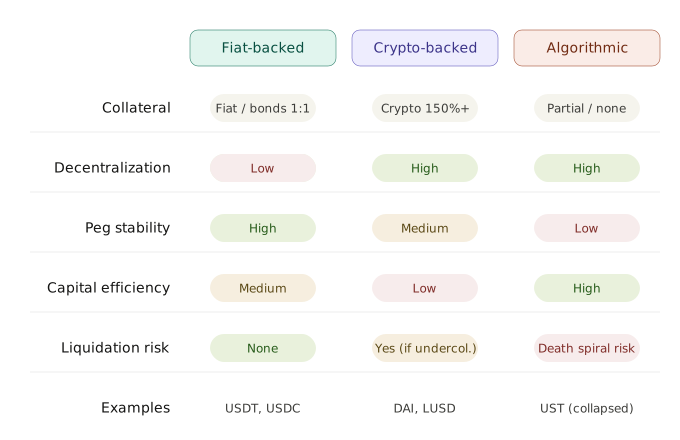
Comparison of Stablecoin Types
| Parameter | Fiat-Backed | Crypto-Backed | Algorithmic |
|---|---|---|---|
| Collateral | Fiat reserves / government bonds | Crypto assets (>100%) | Partial or none |
| Decentralization | Low | High | High |
| Stability | High | Moderate | Low |
| Capital Efficiency | High | Low | High |
| Liquidation Risk | None | Yes (if collateral value falls) | Yes (death spiral risk) |
| Censorship Resistance | Low | High | High |
| Examples | USDT, USDC | DAI, LUSD | Former UST |
Peg Maintenance Mechanism
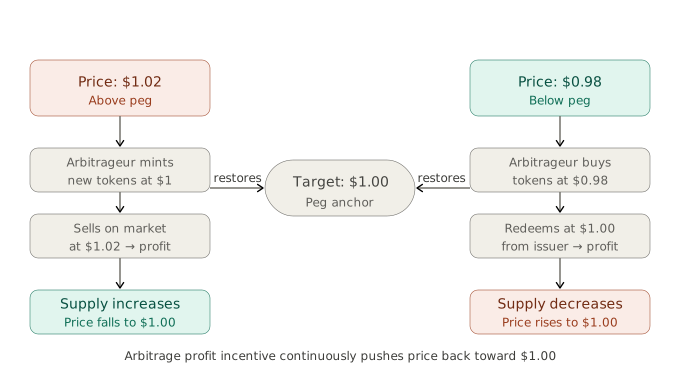
Regardless of their design, all stablecoins rely on arbitrage incentives to help maintain their target price.
When the price is above $1 (e.g., $1.02):
- Fiat-backed stablecoins: the issuer mints new tokens, allowing arbitrageurs to acquire them at $1 and sell them on the market for $1.02.
- Crypto-backed stablecoins: users create new stablecoins by depositing collateral and then sell the newly minted tokens at the higher market price.
When the price is below $1 (e.g., $0.98):
- Fiat-backed stablecoins: arbitrageurs buy discounted tokens on the market and redeem them with the issuer for $1.
- Crypto-backed stablecoins: users purchase discounted stablecoins and use them to repay debt positions, unlocking their collateral at a lower effective cost.
Use Cases of Stablecoins
On Exchanges (Cifra X)
On Cifra X, stablecoins primarily serve as a settlement currency:
- Trading Pairs — most crypto assets are quoted against USDT or USDC (e.g., BTC/USDT, ETH/USDT)
- Profit Preservation — converting into a stablecoin allows users to exit a volatile position without converting to fiat
- Deposits and Withdrawals — stablecoins can be deposited to and withdrawn from external wallet addresses
- Futures Margin — USDT is commonly used as collateral for derivatives trading
In DeFi
- DEX Liquidity — stablecoin-to-stablecoin pools (e.g., Curve) enable low-slippage swaps
- Loan Collateral — users can deposit USDC or DAI to borrow other assets
- Yield Generation — lending stablecoins through lending protocols to earn interest
- Cross-Border Transfers — near-instant USDT and USDC transfers on networks such as Tron and Solana with minimal fees
Key Risks
Depegging Risk
Depegging occurs when a stablecoin loses its intended price peg. The market has experienced several notable examples:
| Event | Date | Impact |
|---|---|---|
| UST/LUNA Collapse | May 2022 | -99.9%; losses exceeding $40 billion |
| USDC Depeg | March 2023 | Dropped by approximately $0.10; recovered within 48 hours |
| Temporary USDT Depeg | May 2022 | Dropped by approximately $0.05; recovered within hours |
| Iron Finance (TITAN) | June 2021 | Complete collapse of the algorithmic model |
Regulatory Risk
Stablecoins remain a major focus of regulators worldwide. Key developments include:
- United States — federal stablecoin legislation continued to advance in 2025, including the proposed GENIUS Act
- European Union — the MiCA regulatory framework, effective since 2024, introduced licensing requirements for stablecoin issuers
- Address Freezing — issuers such as Tether (USDT) and Circle (USDC) have the technical ability to freeze specific wallet addresses in response to regulatory or legal requests
🚨 Centralized Control
Issuers of fiat-backed stablecoins can freeze funds held at specific wallet addresses. This is not a theoretical risk—both Tether and Circle have frozen addresses multiple times in response to requests from law enforcement authorities. If censorship resistance is a priority, consider decentralized alternatives such as DAI or LUSD.
Smart Contract Risk
For crypto-backed stablecoins, vulnerabilities in the protocol's smart contract code may lead to incorrect liquidations or the loss of collateral.
Reserve Risk
For fiat-backed stablecoins, the primary risk is insufficient transparency or inadequate reserves. Historically, Tether has faced criticism over the level of disclosure regarding the composition of its reserves.
Stablecoins and Regulation
Stablecoin regulation has become a major priority for financial regulators around the world.
| Jurisdiction | Status | Requirements |
|---|---|---|
| European Union (MiCA) | In force since 2024 | License, 1:1 reserves, redemption rights |
| United States | Legislation in progress | Licensing, reserve audits |
| Hong Kong | Licensing framework since 2024 | Mandatory reserves, audits |
| Singapore (MAS) | In force since 2023 | MAS license, segregated reserves |
ℹ️ Real-World Assets (RWA)
A growing trend is stablecoins backed by Real-World Assets (RWA), particularly short-term U.S. Treasury securities. Examples include USDY (Ondo) and USDM (Mountain Protocol). These assets combine the price stability of fiat currencies with the potential to earn yield from government bonds.
💡 Helpful Tip
When transferring stablecoins between different blockchain networks (for example, moving USDT from Ethereum to Tron), a standard transfer will not work. You must use a cross-chain bridge or withdraw and redeposit the funds through a cryptocurrency exchange. Sending an ERC-20 token to a TRC-20 address will most likely result in the permanent loss of your funds.