What Is Market Capitalization
Market capitalization (also called market cap) is the total market value of all circulating coins or tokens of a cryptocurrency. It is the most widely used metric for comparing the relative size of cryptocurrencies and assessing their significance within the market.
The calculation is straightforward:
Market Capitalization = Current Price × Circulating Supply
For example, if Bitcoin is trading at $65,000 and there are 19.7 million BTC in circulation:
$65,000 × 19,700,000 = $1,280,500,000,000 (~$1.28 trillion)
Market capitalization allows investors to compare assets regardless of the price of an individual coin. A token priced at $0.001 can have a larger market capitalization than a token worth $500 if the former has a much larger circulating supply.
Types of Market Capitalization
Cryptocurrency analysis commonly uses several market capitalization metrics, each highlighting a different aspect of an asset's size and valuation.
Circulating Market Capitalization
This is the standard and most widely used metric. It includes only the coins or tokens that are currently available on the market—that is, those circulating among users, exchanges, and wallets.
Market Cap = Price × Circulating Supply
This is the figure displayed on platforms such as CoinGecko, CoinMarketCap, and most cryptocurrency trading interfaces.
Fully Diluted Valuation (FDV)
Fully Diluted Valuation (FDV) is calculated using the asset's maximum possible supply, assuming that all coins or tokens—including those that are locked, reserved, or not yet issued—are already in circulation.
FDV = Price × Maximum Supply
ℹ️ Why FDV Matters
FDV helps estimate the potential impact of future token issuance. If an asset's FDV is 10–20 times higher than its current market capitalization, it suggests that a significant number of additional tokens may eventually enter circulation, potentially creating inflationary pressure on the asset's price.
Realized Capitalization (Realized Cap)
Realized capitalization is a metric primarily used for Bitcoin and certain other cryptocurrencies. Instead of valuing every coin at the current market price, it values each coin at the price when it last moved on-chain. This provides an estimate of the actual capital invested rather than the asset's current paper valuation.
| Market Cap Type | Formula | Primary Use |
|---|---|---|
| Circulating Market Cap | Price × Circulating Supply | Standard comparison between assets |
| Fully Diluted Valuation (FDV) | Price × Maximum Supply | Evaluating future token dilution |
| Realized Cap | Sum of (Last Transaction Price × Coin Amount) | Measuring actual invested capital in Bitcoin |
Market Capitalization Categories
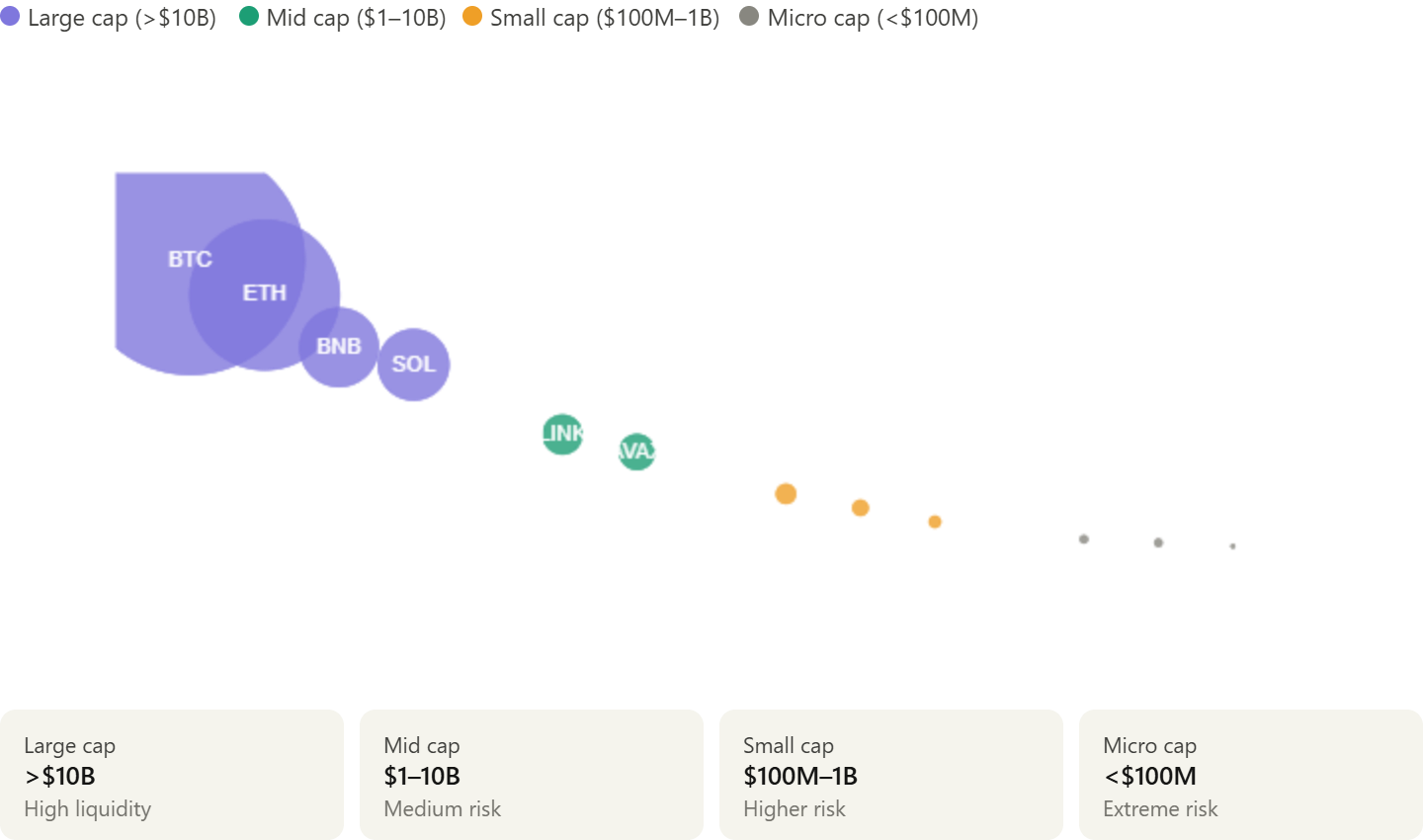
Cryptocurrencies are commonly grouped into categories based on their market capitalization. The thresholds are approximate and evolve as the overall cryptocurrency market changes.
| Category | Market Capitalization | Characteristics | Examples |
|---|---|---|---|
| Large Cap | Over $10 billion | High liquidity, relatively lower volatility | BTC, ETH, SOL, BNB |
| Mid Cap | $1–10 billion | Moderate liquidity, moderate risk | LINK, AVAX, DOT |
| Small Cap | $100 million–$1 billion | Lower liquidity, higher risk and return potential | Many altcoins |
| Micro Cap | Below $100 million | Very low liquidity, extremely high risk | Newly launched and niche tokens |
These thresholds are approximate and may change depending on market conditions.
Bitcoin Dominance (BTC Dominance)
Bitcoin Dominance (BTC Dominance) represents Bitcoin's share of the total cryptocurrency market capitalization. Historically, it has been an important indicator of cryptocurrency market cycles.
BTC Dominance = Bitcoin Market Cap ÷ Total Crypto Market Cap × 100%
| Value | Interpretation |
|---|---|
| >60% | Capital is concentrated in Bitcoin; altcoins are generally under pressure. |
| 50–60% | Moderate Bitcoin dominance; the market is relatively balanced. |
| <50% | Active altseason; capital is flowing into altcoins. |
💡 Helpful Tip
You can track BTC Dominance in real time on TradingView (ticker: BTC.D) or CoinMarketCap. Declining Bitcoin dominance while the overall crypto market continues to grow is often considered a classic signal that an altseason may be beginning.
Why Market Capitalization Is Not the Only Metric
Market capitalization is a useful metric, but it does not tell the whole story. It is important to understand its limitations.
The Low-Liquidity Problem
For low-liquidity tokens, market capitalization can be misleading or artificially inflated. If only a small fraction of the total supply is actively traded, even a modest amount of buying can push the price higher, resulting in a seemingly large market capitalization that does not accurately reflect the asset's true market value.
Example: A token has 1 billion coins in total and trades at $0.01, giving it a market capitalization of $10 million. However, if only 0.1% of the supply is actively traded, the actual market liquidity is only about $10,000.
Locked and Burned Tokens
Some tokens may be permanently or temporarily unavailable for trading because they are locked in vesting schedules, smart contracts, or inaccessible wallets. Depending on the methodology, these tokens may still be included in supply calculations even though they are effectively unavailable to the market.
Market Cap Does Not Measure Utility
Two cryptocurrencies with identical market capitalizations can differ dramatically in terms of real-world adoption, technology, and long-term potential. Market capitalization measures size, not quality.
Related Metrics
For a more complete analysis, market capitalization is typically evaluated alongside other key metrics.
| Metric | What It Measures |
|---|---|
| Market Cap / TVL | For DeFi protocols, compares market valuation with the value locked in the protocol. |
| NVT Ratio | Network Value to Transactions—market capitalization divided by transaction volume; often considered analogous to the P/E ratio for Bitcoin. |
| MVRV (Market Cap / Realized Cap) | Compares market value with realized value to help identify whether Bitcoin may be overvalued or undervalued. |
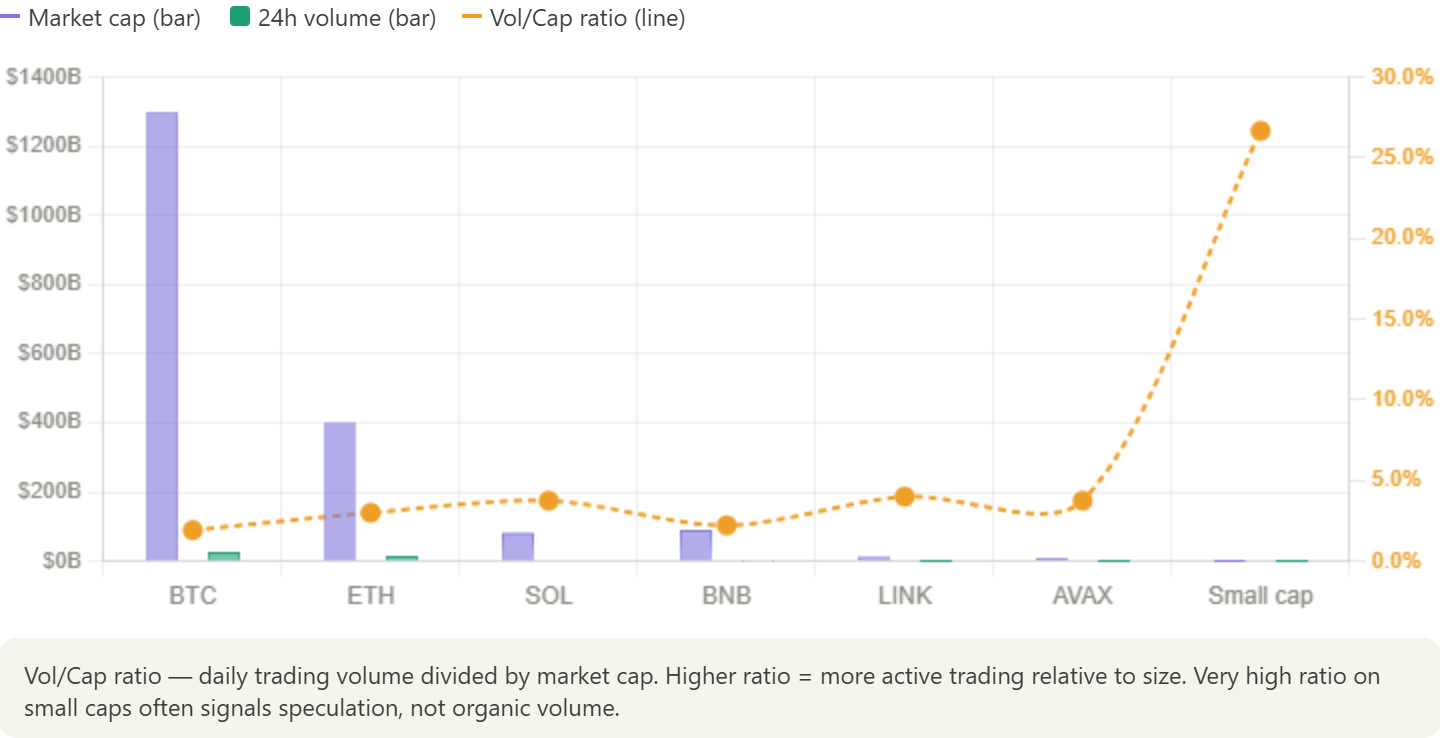
| 24h Volume / Market Cap | Trading activity relative to market capitalization; provides an indirect measure of liquidity. |
Total Cryptocurrency Market Capitalization
In addition to the market capitalization of individual assets, analysts also monitor the Total Market Capitalization, which represents the combined value of the entire cryptocurrency market. This metric reflects the overall inflow and outflow of capital into cryptocurrencies as an asset class.
As of 2025, the total cryptocurrency market capitalization has exceeded $2 trillion during bullish market conditions and has fallen to approximately $700–900 billion during bear market phases.
💡 Helpful Tip
When evaluating a new token, always consider three metrics together: its current market capitalization, Fully Diluted Valuation (FDV), and circulating supply as a percentage of the maximum supply. If less than 20% of the maximum supply is currently in circulation while the FDV is already high, this may indicate significant future inflationary pressure as additional tokens enter the market.