What Is Ethereum?
Ethereum is a decentralized, open-source blockchain platform that enables developers to build and deploy smart contracts and decentralized applications (dApps) without relying on intermediaries. Unlike Bitcoin, which was primarily designed as digital money, Ethereum was conceived as a general-purpose computing platform—a "world computer."
The platform was proposed in 2013 by Vitalik Buterin and launched in July 2015. The network's native currency, Ether (ETH), is used to pay for computational operations and is the second-largest cryptocurrency by market capitalization.
How Ethereum Works
Ethereum Virtual Machine (EVM)
A key component of Ethereum's architecture is the EVM (Ethereum Virtual Machine), an isolated virtual environment in which smart contract code is executed. The EVM operates identically on every network node, ensuring that code produces the same result regardless of which computer executes it.
The EVM is a Turing-complete environment, meaning it can theoretically execute any algorithm. This makes Ethereum a significantly more flexible platform than Bitcoin, whose scripting language is intentionally more limited.
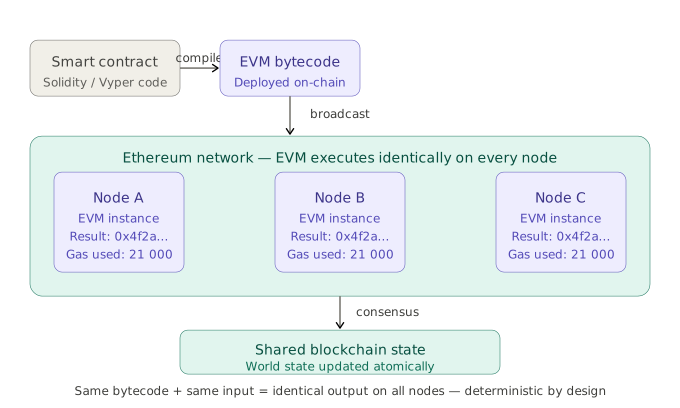
Gas — The Fuel of the Network
Every operation executed within the EVM consumes a certain amount of gas, the unit used to measure computational work. Users specify a gas price in ETH, and the total transaction fee is calculated using the following formula:
Fee = Gas Used × Gas Price (in ETH)
Following the EIP-1559 upgrade in August 2021, Ethereum's fee mechanism was redesigned:
| Component | Description | Recipient |
|---|---|---|
| Base Fee | Minimum gas price determined by the protocol | Burned |
| Priority Fee (Tip) | Additional fee paid for transaction priority | Validator |
| Max Fee | Maximum amount the user is willing to pay | — |
ℹ️ Deflationary Mechanism
The burning of the base fee reduces the total circulating supply of ETH. During periods of high network activity, the amount of ETH burned can exceed the amount issued, making the network deflationary.
Transition to Proof of Stake: The Merge
In September 2022, Ethereum completed its transition from Proof of Work to Proof of Stake in an event known as The Merge. It is considered one of the most significant technical milestones in cryptocurrency history.
| Parameter | Before The Merge (PoW) | After The Merge (PoS) |
|---|---|---|
| Energy Consumption | ~112 TWh/year | ~0.01 TWh/year (-99.95%) |
| Validators | Miners (GPU/ASIC) | Stakers (32 ETH) |
| Rewards | Mining rewards | Staking rewards |
| Finality | Probabilistic | Economic (slashing) |
To participate in network validation, a participant must lock at least 32 ETH as collateral. Violations of protocol rules may result in a portion of the stake being forfeited through a mechanism known as slashing.
Key Technical Parameters
| Parameter | Value |
|---|---|
| Native Token | Ether (ETH) |
| Maximum Supply | Unlimited (regulated through burning) |
| Block Time | ~12 seconds |
| Throughput (L1) | ~15–30 TPS |
| Consensus Mechanism | Proof of Stake |
| Smart Contract Languages | Solidity, Vyper |
| Minimum Validator Stake | 32 ETH |
| Launch Date | July 30, 2015 |
| Block Explorer | etherscan.io |
The Ethereum Ecosystem
Ethereum serves as the foundation for a vast ecosystem of decentralized applications and financial protocols.
DeFi — Decentralized Finance
DeFi (Decentralized Finance) refers to a collection of financial protocols that operate through smart contracts without banks or traditional financial intermediaries.
| Category | Description | Protocol Examples |
|---|---|---|
| DEX | Decentralized exchanges | Uniswap, Curve, Balancer |
| Lending | Borrowing and lending | Aave, Compound, MakerDAO |
| Liquid Staking | Liquid ETH staking | Lido, Rocket Pool |
| Derivatives | Derivatives and perpetual futures | dYdX, GMX, Synthetix |
| Yield | Yield aggregation protocols | Yearn Finance, Convex |
NFTs and Digital Ownership
Ethereum became the leading platform for non-fungible tokens (NFTs). The ERC-721 and ERC-1155 token standards define how unique digital assets can be created and managed, including artwork, gaming items, and digital documents.
DAOs — Decentralized Autonomous Organizations
DAOs are organizations governed by smart contracts and token-holder voting rather than traditional management structures. Examples include MakerDAO, Uniswap DAO, and ENS DAO.
Token Standards
One of Ethereum's most important contributions to the crypto ecosystem is its system of token standards—common interfaces for smart contracts.
| Standard | Type | Use Case |
|---|---|---|
| ERC-20 | Fungible Tokens | USDT, USDC, UNI, LINK, and most DeFi tokens |
| ERC-721 | Non-Fungible Tokens (NFTs) | Unique digital assets and collectibles |
| ERC-1155 | Multi-Token Standard | Gaming assets combining fungible and non-fungible tokens |
| ERC-4626 | Vault Tokens | Standardized yield-bearing vaults in DeFi |
| ERC-4337 | Account Abstraction | Smart wallets with advanced account management logic |
💡 Helpful Tip
When withdrawing Ethereum-based tokens, always ensure that you select the correct network. Many ERC-20 tokens also exist on EVM-compatible networks such as BNB Chain, Polygon, and Arbitrum. Sending assets to the wrong network may result in loss of funds.
Scaling: Layer 2
Ethereum's base layer (L1) intentionally prioritizes decentralization and security over transaction throughput. To address scalability challenges, an ecosystem of Layer 2 solutions has emerged.
Rollups
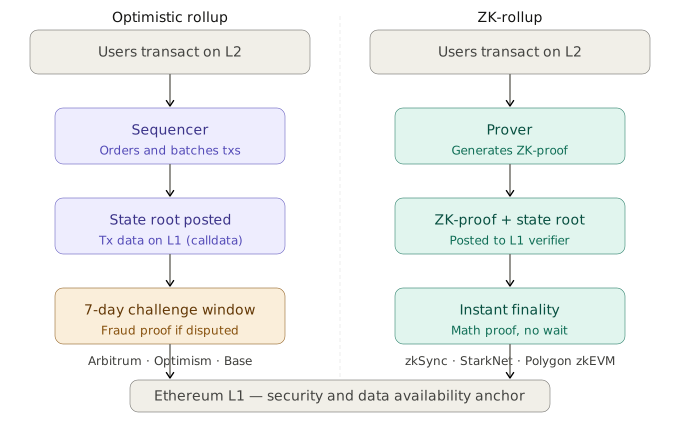
Rollup solutions execute transactions outside the main chain and then publish compressed transaction data and validity proofs to Ethereum L1.
| Type | Principle | Withdrawal Time | Examples |
|---|---|---|---|
| Optimistic Rollup | Transactions are assumed valid unless challenged | 7 days (challenge period) | Arbitrum, Optimism, Base |
| ZK-Rollup | Mathematical proof of correctness (ZK-proof) | Minutes | zkSync, StarkNet, Polygon zkEVM |
Performance Comparison
| Network | TPS | Average Fee | Type |
|---|---|---|---|
| Ethereum L1 | ~15–30 | $1–50+ | Base Layer |
| Arbitrum | ~40,000 | $0.01–0.10 | Optimistic Rollup |
| Optimism | ~2,000 | $0.01–0.10 | Optimistic Rollup |
| zkSync Era | ~100,000+ | <$0.01 | ZK-Rollup |
| StarkNet | ~100,000+ | <$0.01 | ZK-Rollup |
Values are approximate and depend on network activity.
ETH as an Asset
Roles of ETH in the Ecosystem
ETH serves multiple functions simultaneously:
- Gas Payments — every transaction and smart contract interaction on Ethereum requires ETH
- Validator Collateral — participation in consensus requires staking 32 ETH
- DeFi Reserve Asset — ETH is widely used as collateral in lending protocols
- Store of Value — the deflationary issuance model supports long-term demand
Liquid Staking
For users who do not have 32 ETH or who wish to maintain liquidity, liquid staking allows staking through specialized protocols that issue liquid derivative tokens in return.
| Protocol | Token | Key Feature |
|---|---|---|
| Lido | stETH | Largest by TVL, includes centralization risks |
| Rocket Pool | rETH | Decentralized node operators |
| Coinbase | cbETH | Custodial solution aimed at institutional users |
| Frax | frxETH | Dual-token model |
⚠️ Staking Risks
Staking ETH involves risks, including slashing due to validator misbehavior, smart contract risks associated with liquid staking protocols, and the possibility of derivative tokens (such as stETH or rETH) losing parity with ETH.
Ethereum Roadmap
Ethereum follows a staged development roadmap outlined by its core development community. Each phase has its own name and objectives.
| Phase | Name | Key Changes | Status |
|---|---|---|---|
| The Merge | Merge | Transition to PoS | ✅ Completed (2022) |
| The Surge | Surge | Scaling through rollups and sharding | 🔄 In Progress |
| The Scourge | Scourge | Censorship resistance and MEV mitigation | 🔄 In Progress |
| The Verge | Verge | Verkle trees and stateless verification | 📋 Planned |
| The Purge | Purge | Historical data reduction and protocol simplification | 📋 Planned |
| The Splurge | Splurge | Miscellaneous improvements and optimizations | 📋 Planned |
Ethereum and EVM-Compatible Networks
The EVM architecture has become the de facto standard across the blockchain industry. Many blockchains implement EVM compatibility, allowing developers to migrate applications with little or no code modification.
| Network | Type | Compatibility |
|---|---|---|
| BNB Smart Chain | Independent L1 | Full EVM Compatibility |
| Polygon PoS | Sidechain | Full EVM Compatibility |
| Avalanche C-Chain | Subnet | Full EVM Compatibility |
| Fantom | Independent L1 | Full EVM Compatibility |
| Arbitrum | Ethereum L2 | Full EVM Compatibility |
| Optimism / Base | Ethereum L2 | Full EVM Compatibility |
🚨 Transfer Warning
EVM compatibility means wallet addresses look identical across different networks. Sending ERC-20 tokens through the wrong network (for example, sending ETH via BNB Chain instead of Ethereum) may result in irreversible loss of funds if the recipient does not control the destination network.
Advantages and Risks
Advantages
- Programmability — the Turing-complete EVM enables virtually any financial logic to be implemented
- Network Effect — the largest ecosystem of developers, protocols, and liquidity
- Security — more than $50 billion worth of ETH staked provides a high cost of attack
- Standards — ERC-20, ERC-721, and other standards ensure interoperability across protocols
- Active Development — a clear roadmap and one of the largest developer communities in the industry
Risks
⚠️ Risk Warning
ETH is a highly volatile asset. Investments in ETH and Ethereum ecosystem tokens involve the risk of partial or total loss of capital. Interacting with DeFi smart contracts introduces additional technical risks.
- High L1 Fees — during periods of congestion, transaction fees can reach tens of dollars
- Complexity — the DeFi ecosystem is technically complex, and user mistakes are often irreversible
- Smart Contract Risks — vulnerabilities in protocol code may lead to loss of funds
- Regulatory Uncertainty — the classification of ETH as a security remains debated in some jurisdictions
- Competition — growing competition from alternative Layer 1 networks such as Solana, Sui, and Aptos, as well as emerging Layer 2 solutions
💡 Helpful Tip
Before sending ETH or ERC-20 tokens, check current network conditions on etherscan.io or ultrasound.money. This can help you choose a time when network fees are lower and transactions are more cost-effective.