What Is Blockchain and How It Works
Blockchain is a distributed database in which records are organized as a sequential chain of cryptographically linked blocks. Each participant in the network maintains a full or partial copy of this ledger, and any modification of the data requires consensus among the majority of participants. This architecture makes blockchain resistant to tampering and centralized control.
The technology was conceptualized in 2008 in the Bitcoin Whitepaper authored by Satoshi Nakamoto and was first implemented in January 2009. Today, blockchain is used far beyond cryptocurrencies, including in logistics, healthcare, digital law, and financial protocols.
How Blockchain Works
Block Structure
Each block in the chain contains three main components:
| Component | Description |
|---|---|
| Header | Metadata including the block hash, previous block hash, timestamp, and nonce |
| Body | A list of transactions or data included in the block |
| Block Hash | A unique cryptographic fingerprint of the block's entire contents |
Hashing — The Foundation of Integrity
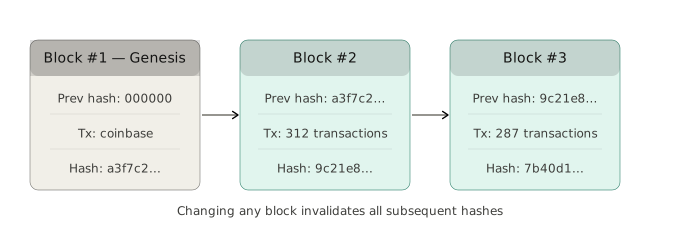
A hash function takes data of any size and produces a fixed-length string. Its key property is that even the smallest change to the input data results in a completely different output.
Because each block contains the hash of the previous block, modifying any historical block changes all subsequent hashes in the chain, which is immediately detected by the network.
ℹ️ The First Block
The very first block in a blockchain is called the Genesis Block. It has no previous hash, making it the only exception to the standard block structure.
How a New Block Is Added
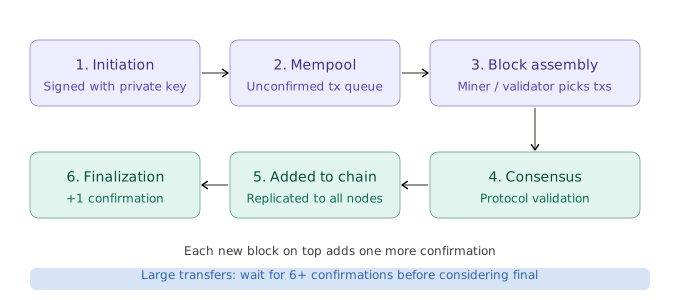
The process of adding a new block consists of several mandatory stages:
- Transaction Initiation — a user signs a transaction with their private key and broadcasts it to the network.
- Propagation — the transaction enters the mempool, a queue of unconfirmed transactions.
- Block Creation — a validator or miner selects transactions from the mempool and assembles a new block.
- Consensus — the block is verified according to the protocol's rules (PoW, PoS, etc.).
- Chain Inclusion — the validated block is added to the blockchain and replicated across all network nodes.
- Finalization — with each new block added on top, the transaction receives an additional confirmation.
💡 Helpful Tip
The number of confirmations affects transaction security. For small transfers, 1–3 confirmations are usually sufficient. For larger amounts, exchanges and services may require 6 or more confirmations.
Types of Blockchains
Blockchains differ in their level of openness and governance model:
| Type | Read Access | Consensus Participation | Governance | Examples |
|---|---|---|---|---|
| Public | Open | Anyone | Decentralized | Bitcoin, Ethereum |
| Private | Restricted | Authorized participants only | Centralized | Hyperledger Fabric |
| Consortium | Partially open | Group of organizations | Collaborative | R3 Corda, Quorum |
| Hybrid | Mixed | Configurable | Mixed | Dragonchain |
Public Blockchains
Fully open networks where anyone can read data, submit transactions, and, if they have sufficient resources, participate in validation. They offer maximum decentralization but relatively low throughput.
Private Blockchains
Controlled by a single organization. In essence, they are distributed databases secured by cryptography. They provide high speed and privacy, but centralization reduces many of the technology's key advantages.
Consortium Blockchains
Managed by a group of organizations. Common use cases include interbank settlements, supply chain management, and healthcare records.
Consensus Mechanisms
Proof of Work (PoW)
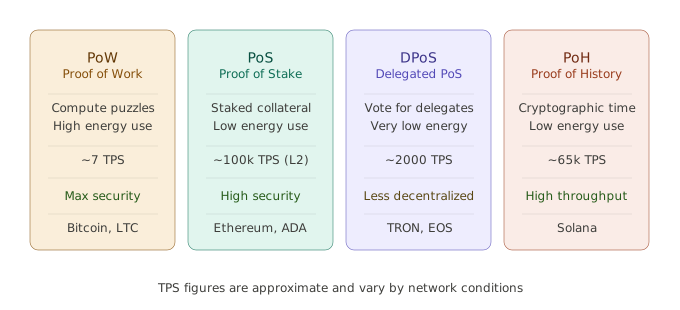
Miners repeatedly calculate a block hash, changing the value of the nonce until the result is lower than a predefined target value. This process requires substantial computational resources.
- ✅ Highly proven security model
- ✅ Attacks are objectively expensive to execute
- ❌ High energy consumption
- ❌ Low transaction throughput
Proof of Stake (PoS)
Validators lock their own coins as collateral (stake). The right to create the next block is selected pseudorandomly, taking the size of the stake into account. If a validator behaves dishonestly, part of their stake is forfeited through a mechanism known as slashing.
- ✅ Low energy consumption
- ✅ Greater scalability
- ❌ Risk of influence becoming concentrated among large holders
- ❌ Less battle-tested historically than PoW
Other Consensus Mechanisms
| Mechanism | Core Idea | Usage |
|---|---|---|
| DPoS | Voting for delegates | TRON, EOS |
| PoH | Proof of chronological ordering | Solana |
| PoA | Authorized validators with established reputations | BSC, private networks |
| PBFT | Mathematical agreement between nodes | Hyperledger, some Layer 2 solutions |
Smart Contracts
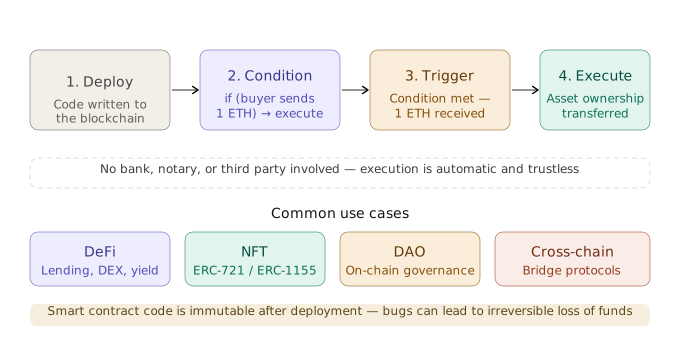
A smart contract is a piece of code deployed directly on a blockchain. It executes automatically when predefined conditions are met, without the need for intermediaries.
Smart contracts form the foundation of:
- DeFi (Decentralized Finance) — lending protocols, decentralized exchanges (DEXs), and staking platforms
- NFTs — ERC-721 and ERC-1155 token standards
- DAOs (Decentralized Autonomous Organizations)
- Cross-Chain Bridges — mechanisms for transferring assets between blockchains
⚠️ Smart Contract Risks
Smart contract code is generally immutable after deployment. Bugs and vulnerabilities in the code can lead to irreversible loss of funds. Always verify that protocols you trust with your assets have undergone independent security audits.
Scalability and the Blockchain Trilemma
Vitalik Buterin formulated the blockchain trilemma: no system can fully achieve all three properties simultaneously—security, decentralization, and scalability. Improving any two typically comes at the expense of the third.
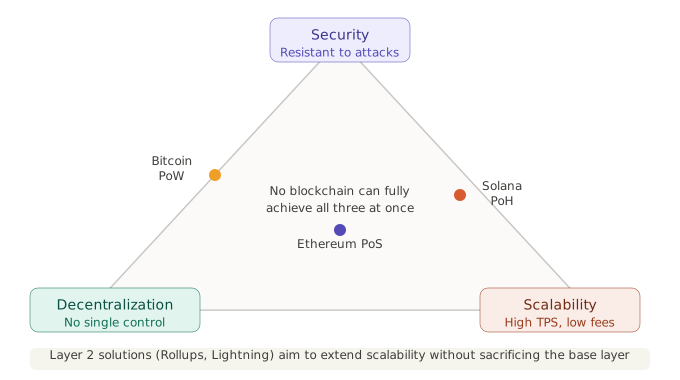
| Property | Description |
|---|---|
| Security | Resistance to attacks and tampering |
| Decentralization | Absence of a single controlling authority |
| Scalability | High throughput and low transaction costs |
To address the trilemma, developers are building Layer 2 solutions:
- Lightning Network — payment channels for Bitcoin
- Optimistic Rollups and ZK-Rollups — batch transaction processing for Ethereum
- State Channels, Plasma, and Validium — alternative architectural approaches
Practical Applications of Blockchain
| Industry | Application |
|---|---|
| Finance | Instant international transfers, DeFi, asset tokenization |
| Logistics | Supply chain tracking (Walmart, Maersk) |
| Healthcare | Secure sharing of medical data |
| Digital Rights | NFTs, proof of authorship, intellectual property registries |
| Voting | Verifiable electronic elections |
| Gaming and Metaverses | Ownership of in-game assets, Play-to-Earn models |
Limitations of the Technology
Blockchain is not a universal solution. It is important to understand its practical limitations:
- Irreversibility — an incorrect transaction cannot be reversed without network consensus
- Scalability — public blockchains process significantly fewer transactions than traditional payment systems (Visa ≈ 24,000 TPS, Bitcoin ≈ 7 TPS)
- Energy Consumption — PoW networks require substantial amounts of electricity
- Privacy — public data visibility may be undesirable in certain use cases
- The Oracle Problem — blockchains cannot independently verify information from the external world
ℹ️ Oracles
To obtain external data such as exchange rates, weather information, or sports results, smart contracts rely on oracles—specialized intermediary services. One of the most widely used oracle networks is Chainlink (LINK).
💡 Helpful Tip
To explore transactions and blocks on the Bitcoin network yourself, use a public block explorer such as mempool.space. For Ethereum, use Etherscan. These tools are free and do not require registration.