What is cryptocurrency?
A cryptocurrency is a digital asset that exists exclusively in electronic form and uses cryptographic methods to secure transactions, control issuance, and verify the transfer of funds. Unlike traditional currencies, cryptocurrencies are decentralized: no government, bank, or organization controls their issuance or circulation.
The first and most well-known cryptocurrency was Bitcoin (BTC), launched in 2009 by an anonymous creator under the pseudonym Satoshi Nakamoto. Since then, the ecosystem has grown to include thousands of assets with varying technical specifications, economic models, and use cases.
How Cryptocurrency Works
The technological foundation: blockchain
Most cryptocurrencies are built on blockchain technology—a distributed ledger in which all transactions are recorded in chronologically ordered blocks. Each block is cryptographically linked to the previous one, making it virtually impossible to alter historical data.
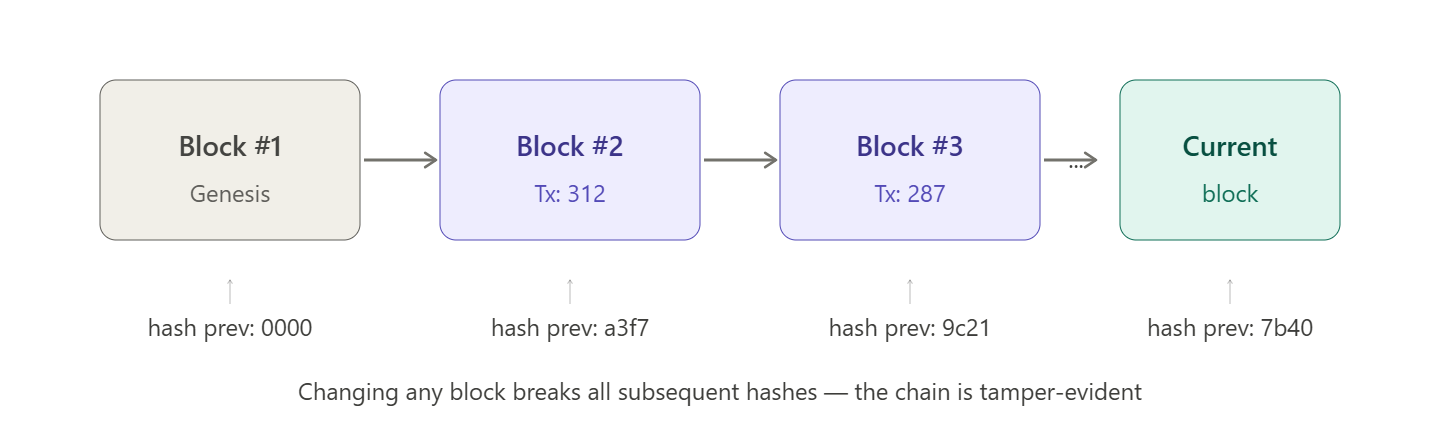
Key properties of blockchain:
- Decentralization — data is stored on thousands of independent nodes around the world
- Transparency — all transactions are publicly verifiable
- Immutability — it is extremely difficult to alter recorded data retroactively
- Fault tolerance — no single point of failure
Consensus mechanisms
To validate transactions, networks use consensus mechanisms — rules by which network participants agree on the validity of new blocks.
| Mechanism | Description | Examples |
|---|---|---|
| Proof of Work (PoW) | Miners solve computational puzzles, consuming energy to validate transactions and secure the network | Bitcoin, Litecoin |
| Proof of Stake (PoS) | Validators lock up (stake) coins as collateral to participate in block validation | Ethereum, Cardano |
| Delegated Proof of Stake (DPoS) | Token holders vote for delegates who validate transactions and produce blocks | TRON, EOS |
| Proof of History (PoH) | A cryptographic method for proving the chronological order of events and transactions | Solana |
Wallets and Addresses
To store and transfer cryptocurrency, users utilize cryptocurrency wallets. Technically, a wallet does not store the coins themselves; instead, it stores a pair of cryptographic keys:
- Public key (address) — similar to a bank account number; it can be shared freely with others.
- Private key — similar to a PIN code and password combined; whoever possesses it has full control over the associated funds.
⚠️ Critically Important
A private key must never be shared with anyone under any circumstances. Losing it usually means permanent loss of access to your funds. No legitimate exchange, wallet provider, or cryptocurrency service will ever ask for your private key.
Main Types of Cryptocurrencies
The term cryptocurrency encompasses several fundamentally different classes of digital assets:
1. Coins
Native assets of individual blockchains. They are used to pay network fees and as a means of exchange.
Examples: Bitcoin (BTC), Ether (ETH), Solana (SOL), Litecoin (LTC)
2. Tokens
Created on top of existing blockchains using smart contracts. They can represent rights, utility functions, or ownership interests in a project.
Examples: USDT (Tether), UNI (Uniswap), LINK (Chainlink)
3. Stablecoins
Crypto assets pegged to the value of traditional currencies or commodities to minimize volatility.
| Stablecoin Type | Backing | Examples |
|---|---|---|
| Fiat-backed | Reserves held in USD/EUR | USDT, USDC, FDUSD |
| Crypto-backed | Overcollateralized with cryptocurrency | DAI |
| Algorithmic | Supply-adjustment algorithm | FRAX |
⚠️Stablecoin Risks
Stablecoins are not risk-free assets. There have been cases of depegging, where a stablecoin loses its peg to the underlying reference asset (for example, the collapse of UST/LUNA in 2022).
4. Wrapped Tokens
These represent assets from one blockchain on another blockchain. For example, WBTC is Bitcoin wrapped into the ERC-20 standard for use within the Ethereum ecosystem.
Key Cryptocurrency Characteristics
When evaluating any crypto asset, it is important to analyze the following parameters:
| Parameter | Meaning |
|---|---|
| Market Capitalization | Price × Number of coins in circulation |
| Maximum Supply | The upper limit on the total number of coins (may not exist) |
| Circulating Supply | The number of coins currently in circulation |
| Transaction Speed (TPS) | The network's throughput measured in transactions per second |
| Network Fee (Gas) | The cost of executing a transaction |
| Level of Decentralization | The degree to which governance and validation are distributed |
How Cryptocurrency Differs from Traditional Money
| Characteristic | Cryptocurrency | Fiat Money |
|---|---|---|
| Issuer | Algorithm / protocol | Central bank |
| Control | Decentralized | Government-controlled |
| Transparency | Public ledger | Closed banking systems |
| Volatility | High | Low (in stable economies) |
| Transactions | 24/7, without intermediaries | Banking hours, intermediaries |
| Reversibility | Generally irreversible | Can be disputed or reversed |
| Anonymity | Pseudonymous | Identity-based |
Benefits and Risks
Benefits
- Financial Inclusion — access to financial services without a bank account
- Censorship Resistance — transactions cannot be centrally blocked
- Programmability — smart contracts enable the automation of financial operations
- Global Accessibility — instant cross-border transfers without currency conversion
- Transparency — a verifiable history of all transactions is publicly available
Risks
⚠️ Risk Warning
Cryptocurrencies are high-risk assets. Their value can decline to zero. Only invest funds that you can afford to lose.
- High Volatility — an asset's price can change by dozens of percent within hours
- Regulatory Risk — legislation in different countries may restrict or prohibit cryptocurrency usage
- Technical Risks — smart contract bugs and protocol vulnerabilities
- Access Loss Risk — losing a private key or seed phrase is irreversible
- Fraud Risk — a high prevalence of scam projects, phishing attacks, and pump-and-dump schemes
💡Helpful Tip
Before you start trading, it is recommended to learn the basics: how to read a trading chart, what an order book is, and the difference between a market order and a limit order. These topics are covered in detail in the relevant Cifra X Wiki articles.