What's the Difference Between Coins and Tokens
In the cryptocurrency industry, the terms coin and token are often used interchangeably. However, they represent two fundamentally different types of digital assets. Understanding this distinction is important for evaluating crypto assets, selecting the correct blockchain network for transfers, and understanding how a project works.
A coin is the native asset of its own blockchain. A token is a digital asset created on top of an existing blockchain using a smart contract. This distinction affects everything from technical characteristics and economic models to how the asset is stored and transferred.
Coins: Native Blockchain Assets
A coin exists within its own blockchain and is an integral part of the network. Without it, the blockchain cannot function. Coins are used to pay transaction fees to validators and provide the economic incentives that keep the network secure.
Key Characteristics of Coins
- Native asset — built directly into the blockchain protocol rather than implemented as a smart contract
- Gas payments — all transactions on the network, including token transfers, are paid for using the native coin
- Protocol issuance — new coins are created according to the blockchain's consensus rules (mining or staking)
- Independence — exists independently of any applications or smart contracts
Examples of Coins
| Coin | Ticker | Blockchain | Consensus Mechanism |
|---|---|---|---|
| Bitcoin | BTC | Bitcoin | Proof of Work |
| Ether | ETH | Ethereum | Proof of Stake |
| Solana | SOL | Solana | Proof of History + PoS |
| BNB | BNB | BNB Chain | Proof of Staked Authority |
| Avalanche | AVAX | Avalanche | Avalanche Consensus |
| Cardano | ADA | Cardano | Ouroboros PoS |
| Toncoin | TON | TON | Proof of Stake |
Tokens: Assets Built on Smart Contracts
A token is a smart contract deployed on an existing blockchain. It does not have its own blockchain. All token transactions take place on the underlying network and require payment in that network's native coin.
Key Characteristics of Tokens
- Smart contract — a token exists as program code with its own contract address on the blockchain
- Dependent on the underlying network — transferring a token requires the native coin of the blockchain (for example, ETH is required to transfer ERC-20 tokens)
- Created by developers — anyone can issue a token without launching a new blockchain
- Contract address — every token is identified by its smart contract address, not just its ticker symbol
Token Standards
Most tokens follow standardized interfaces that ensure compatibility with wallets, exchanges, and decentralized applications.
| Standard | Network | Type | Description |
|---|---|---|---|
| ERC-20 | Ethereum | Fungible | The primary standard for DeFi tokens |
| ERC-721 | Ethereum | NFT | Standard for unique non-fungible tokens |
| ERC-1155 | Ethereum | Multi-token | Supports both fungible and non-fungible assets in one contract |
| BEP-20 | BNB Chain | Fungible | ERC-20 equivalent for BNB Chain |
| SPL | Solana | Fungible | Solana token standard |
| TRC-20 | Tron | Fungible | Tron token standard |
| Jetton | TON | Fungible | TON token standard |
Examples of Tokens
| Token | Ticker | Standard | Purpose |
|---|---|---|---|
| Tether | USDT | ERC-20 / TRC-20 / BEP-20 | Stablecoin |
| USD Coin | USDC | ERC-20 / SPL | Stablecoin |
| Uniswap | UNI | ERC-20 | Protocol governance |
| Chainlink | LINK | ERC-20 | Oracle network payments |
| Shiba Inu | SHIB | ERC-20 | Meme token |
| Wrapped Bitcoin | WBTC | ERC-20 | Bitcoin on the Ethereum network |
Comparing Coins and Tokens
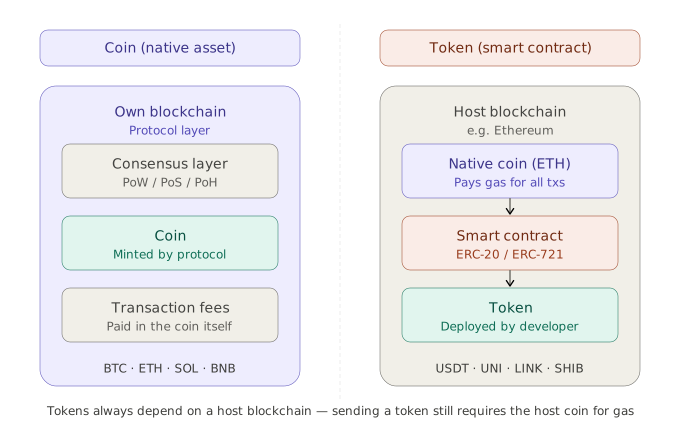
| Parameter | Coin | Token |
|---|---|---|
| Own blockchain | Yes | No |
| Technical implementation | Built into the protocol | Smart contract |
| Transaction fees | Paid with the native coin | Paid with the underlying network's native coin |
| Creation | Mining / staking | Smart contract deployment |
| Identifier | Ticker | Contract address |
| Examples | BTC, ETH, SOL, BNB | USDT, UNI, LINK, SHIB |
| Launch cost | High (requires a blockchain) | Low (can be deployed in minutes) |
Types of Tokens by Purpose
Tokens differ not only technically but also by their economic role within a blockchain ecosystem.
Utility Tokens
Utility tokens provide access to a product or service within a specific protocol. They are intended for use rather than investment returns.
Examples: LINK (payment for Chainlink oracle services), FIL (payment for Filecoin storage), GRT (payment for queries on The Graph)
Governance Tokens
Governance tokens allow holders to vote on protocol decisions, such as parameter changes, treasury management, and software upgrades.
Examples: UNI (Uniswap), AAVE (Aave), MKR (MakerDAO), CRV (Curve)
Liquidity Provider (LP) Tokens
LP tokens are issued to liquidity providers in decentralized exchanges (DEXs) as proof of their deposited liquidity. They can later be redeemed to withdraw the deposited assets.
Examples: UNI-V2, Curve LP Tokens, Balancer BPT
Yield / Receipt Tokens
These tokens represent assets deposited into staking or lending protocols and automatically accumulate generated yield.
Examples: stETH (Lido), aUSDC (Aave), cETH (Compound)
NFTs (Non-Fungible Tokens)
NFTs are unique digital assets where every token is distinct. They are commonly used to represent ownership of digital collectibles, artwork, gaming items, and other unique assets.
Examples: CryptoPunks, Bored Ape Yacht Club, in-game items
Meme Tokens
Meme tokens are created primarily as internet or community-driven phenomena without an initial practical utility. Their value is largely driven by speculation and community interest.
⚠️ Meme Token Risk
Meme tokens are considered high-risk assets. Most have little or no fundamental value and are highly susceptible to pump-and-dump schemes and market manipulation. Losing 100% of your investment is a common outcome when investing in meme tokens.
Important: One Token Can Exist on Multiple Networks
The same token (for example, USDT) can exist on multiple blockchains simultaneously as separate smart contracts. Understanding this is essential when transferring cryptocurrency.
| Token | Network | Standard | Network Fee | Native Coin Required for Gas |
|---|---|---|---|---|
| USDT | Ethereum | ERC-20 | $1–20 | ETH |
| USDT | Tron | TRC-20 | $0.5–1 | TRX |
| USDT | BNB Chain | BEP-20 | < $0.1 | BNB |
| USDT | Solana | SPL | < $0.01 | SOL |
⚠️ Critical Warning
Sending a token through the wrong blockchain network can result in the permanent loss of your funds. For example, ERC-20 and BEP-20 wallet addresses both begin with 0x and look almost identical. Always confirm which network the recipient expects before sending cryptocurrency.
How to Verify a Token Before Buying
Because anyone can create a token with any name or ticker symbol, counterfeit and scam tokens are common. The most reliable way to verify a token is by checking its smart contract address.
- Find the official contract address — only from the project's official website, GitHub repository, or trusted sources such as CoinGecko or CoinMarketCap.
- Verify the address using a blockchain explorer (such as Etherscan, BscScan, or Solscan).
- Check contract verification — legitimate projects usually publish and verify their smart contract source code.
- Review liquidity and project history — newly created contracts with little trading history should be treated with extra caution.
💡 Helpful Tip
All tokens listed on Cifra X undergo a listing and verification process. When interacting with DeFi protocols, always obtain the token's contract address from official sources. Never copy contract addresses from comments, Telegram groups, social media posts, or advertisements.