What Is DeFi?
DeFi (Decentralized Finance) is an ecosystem of financial applications and protocols built on public blockchains that operate without traditional financial intermediaries such as banks, brokers, insurance companies, or clearing houses. Instead of relying on trusted institutions, users rely on transparent smart contract code that executes automatically and can be publicly verified.
The term DeFi became widely adopted in 2018–2019 alongside the rapid growth of Ethereum-based protocols. As of 2025, the total value locked (TVL) in DeFi protocols amounts to hundreds of billions of dollars, and the ecosystem includes thousands of applications ranging from simple decentralized exchanges to sophisticated derivatives platforms.
How DeFi Differs from Traditional Finance
| Feature | Traditional Finance (CeFi) | DeFi |
|---|---|---|
| Intermediary | Bank, broker, exchange | Smart contract |
| Access | KYC, citizenship, credit history | Anyone with a wallet and internet access |
| Availability | Banking hours, weekends | 24/7/365 |
| Transparency | Closed systems | Public code and on-chain transactions |
| Asset Custody | Held by an intermediary | Held by the user (self-custody) |
| Censorship | Possible | Technically censorship-resistant |
| Error Recovery | Transactions may be disputed | Transactions are generally irreversible |
| Regulation | Well-established | Evolving and less defined |
How DeFi Works
The foundation of DeFi is the smart contract—a program deployed on a blockchain that automatically executes predefined actions when specific conditions are met. Users interact directly with these protocols through cryptocurrency wallets (such as MetaMask, Phantom, and others) by signing transactions with their private keys.
Core Principles
- Permissionless — no approval, identification, or authorization is required to access the protocol.
- Trustless — users rely on the protocol's code rather than a company or individual.
- Composability ("Money Legos") — different protocols can be combined, allowing assets from one protocol to be used within another to create more advanced financial strategies.
- Transparent — smart contract code is publicly available, and all blockchain transactions can be independently verified.
- Non-custodial — users retain full control of their private keys and digital assets.
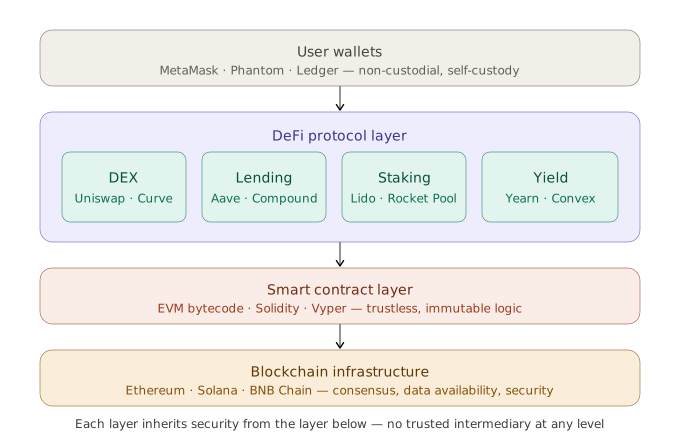
Main Categories of DeFi Protocols
Decentralized Exchanges (DEXs)
Decentralized Exchanges (DEXs) allow users to trade tokens directly without relying on a centralized intermediary. There are two primary trading models:
Automated Market Maker (AMM) — prices are determined algorithmically based on the ratio of assets within a liquidity pool. Liquidity providers (LPs) deposit token pairs into the pool and earn a share of the trading fees.
Order Book DEX — uses a traditional order book, but order matching and settlement occur on-chain or on a Layer 2 network.
| Protocol | Type | Network | Key Feature |
|---|---|---|---|
| Uniswap v3 | AMM | Ethereum, L2 | Concentrated liquidity |
| Curve | AMM | Ethereum, Multichain | Optimized for stablecoins |
| Balancer | AMM | Ethereum, L2 | Multi-token liquidity pools |
| dYdX | Order Book | Cosmos L1 | Derivatives and perpetual futures |
| Jupiter | Aggregator | Solana | Best-price routing across DEXs |
Lending & Borrowing Protocols
These protocols allow lenders to deposit assets and earn interest, while borrowers can obtain crypto-backed loans without a credit check.
Loans are always overcollateralized, meaning the collateral value exceeds the borrowed amount. If the collateral value falls below the liquidation threshold, the smart contract automatically sells the collateral to repay the loan.
| Protocol | TVL (2025) | Supported Assets | Key Feature |
|---|---|---|---|
| Aave v3 | $10B+ | ETH, BTC, Stablecoins | Multichain, flash loans |
| Compound | $2B+ | ERC-20 Assets | First major lending protocol |
| MakerDAO / Sky | $5B+ | ETH, RWAs, others | Issuer of DAI / USDS |
| Morpho | $3B+ | ERC-20 Assets | Interest rate optimization for Aave & Compound |
ℹ️ Flash Loans
A flash loan is an uncollateralized loan that must be borrowed and repaid within the same blockchain transaction. If repayment fails, the entire transaction is automatically reverted. Flash loans are commonly used for arbitrage, liquidations, and refinancing positions.
Staking and Liquid Staking
Staking involves locking tokens to help secure a Proof-of-Stake blockchain or to earn protocol rewards.
Liquid staking solves the liquidity problem by allowing users to stake assets (such as ETH) while receiving a liquid derivative token (for example, stETH or rETH) that can still be used throughout the DeFi ecosystem.
| Protocol | Token | TVL | Mechanism |
|---|---|---|---|
| Lido | stETH | $30B+ | Validator pool |
| Rocket Pool | rETH | $4B+ | Decentralized mini-pools |
| EigenLayer | — | $15B+ | Restaking for AVS security |
Yield Aggregators
Yield aggregators automatically move funds between DeFi protocols to maximize returns and reinvest rewards without requiring manual user intervention.
Examples: Yearn Finance, Convex Finance, Beefy Finance
Derivatives and Synthetic Assets
These protocols enable trading of financial derivatives such as perpetual futures, options, and synthetic assets that track the value of real-world or digital assets.
Examples: GMX, Synthetix, Lyra Finance, Hegic
Cross-Chain Bridges
Bridge protocols enable the transfer of assets and data between different blockchain networks.
Examples: Stargate, LayerZero, Wormhole, Across Protocol
Key DeFi Metrics
When evaluating DeFi protocols, several industry-standard metrics are commonly used.
| Metric | Description |
|---|---|
| TVL (Total Value Locked) | Total value of assets deposited in a protocol |
| APY / APR | Annual yield with (APY) or without (APR) compounding |
| Trading Volume | Total trading volume over a given period (DEXs) |
| Utilization Rate | Percentage of deposited assets currently borrowed (lending protocols) |
| Protocol Revenue | Revenue generated from protocol fees |
| Token Emissions | Amount of governance tokens distributed as user incentives |
💡 Helpful Tip
You can track current TVL, trading volumes, and protocol performance using popular analytics platforms such as DeFiLlama (for TVL and protocol statistics), DefiPulse, and Dune Analytics (for on-chain analytics).
How Users Earn Income in DeFi
Providing Liquidity (Liquidity Providing)
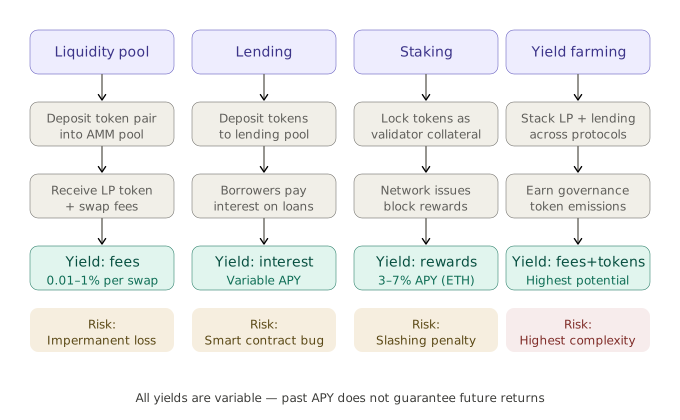
Users deposit a pair of tokens into an AMM liquidity pool and receive a share of the trading fees generated by swaps within that pool.
In return, they receive an LP Token, which represents their ownership share in the liquidity pool.
⚠️ Impermanent Loss
When the relative prices of the pooled assets change, liquidity providers may end up with fewer assets than if they had simply held them in their wallet. This phenomenon is known as Impermanent Loss. Trading fees may offset these losses—but they do not always fully compensate for them.
Lending
Users deposit cryptocurrency into lending protocols and earn interest.
Interest rates are determined dynamically based on borrowing demand.
Yield Farming
Yield farming is a strategy for maximizing returns by using multiple DeFi protocols in combination.
Many strategies also reward users with governance tokens in addition to standard interest or trading fees.
Staking Governance Tokens
Some protocols allow users to stake their governance tokens in exchange for a share of the protocol's revenue or transaction fees.
Risks of DeFi
DeFi offers a wide range of financial opportunities, but it also introduces unique risks that do not exist in traditional financial systems.
⚠️ Risk Warning
DeFi protocols are high-risk financial products. Using them may result in a partial or complete loss of your funds. Unlike traditional financial institutions, DeFi does not provide depositor protection or regulatory guarantees.
Smart Contract Risk
Bugs or vulnerabilities in smart contract code may be exploited by attackers to steal or drain user funds. The history of DeFi includes numerous large-scale security breaches.
| Incident | Year | Estimated Loss |
|---|---|---|
| Ronin Bridge (Axie Infinity) | 2022 | ~$625 million |
| Poly Network | 2021 | ~$611 million |
| Wormhole Bridge | 2022 | ~$320 million |
| Euler Finance | 2023 | ~$197 million |
| Curve Finance | 2023 | ~$70 million |
Liquidation Risk
Lending protocols require borrowers to maintain sufficient collateral. If the value of the collateral falls below the liquidation threshold, the position is automatically liquidated.
During periods of high market volatility, liquidations can occur rapidly and at unfavorable prices.
Oracle Risk
Many DeFi protocols rely on price oracles—external services that provide market price data.
Oracle manipulation, including attacks involving flash loans, may trigger incorrect liquidations or allow protocol exploits.
Regulatory Risk
The legal status of DeFi remains uncertain in many jurisdictions.
Future regulatory changes may restrict access to certain protocols or create new tax and compliance obligations.
MEV and Front-Running
MEV (Maximal Extractable Value) refers to the practice of bots monitoring the mempool and inserting their own transactions ahead of large user transactions.
This can result in worse execution prices and increased transaction costs for users.
🚨 Irreversible Transactions
DeFi has no customer support and no transaction reversal mechanism. Sending funds to the wrong address, interacting with a malicious smart contract, or approving a fraudulent transaction can result in the permanent loss of your assets.
DeFi vs. Cifra X
Cifra X is a centralized exchange (CeFi). Understanding the differences between CeFi and DeFi helps you choose the right solution for your needs.
| Feature | Cifra X (CeFi) | DeFi Protocol |
|---|---|---|
| Asset Custody | Exchange-managed (custodial) | User-managed (non-custodial) |
| KYC Verification | Required | Not required |
| Customer Support | Available | Not available |
| Protection Against User Errors | Limited | None |
| Ease of Use | Beginner-friendly | More complex |
| Available Assets | Listed assets only | Virtually any supported token |
| Regulation | Operates under applicable licensing requirements | Generally unregulated |
💡 Helpful Tip
If you're new to DeFi, start with small amounts and use only well-established protocols that have been operating successfully for a long time and have undergone multiple independent security audits. Never sign a blockchain transaction unless you fully understand what you are approving.