What Is a Market Order
A market order is an order to buy or sell an asset immediately at the best available market price at the time of execution. Unlike a limit order, a market order does not require you to specify a price—the exchange automatically matches it against the best available orders in the order book and executes it instantly.
The key characteristic of a market order is that it guarantees execution but does not guarantee the execution price. Your order will be filled, but the final execution price depends on the state of the order book at the moment the order is submitted.
How a Market Order Works
Execution Mechanism
When you submit a market buy order, the exchange sequentially consumes orders from the ask side of the order book, starting with the lowest available price. A market sell order consumes orders from the bid side, starting with the highest available price.
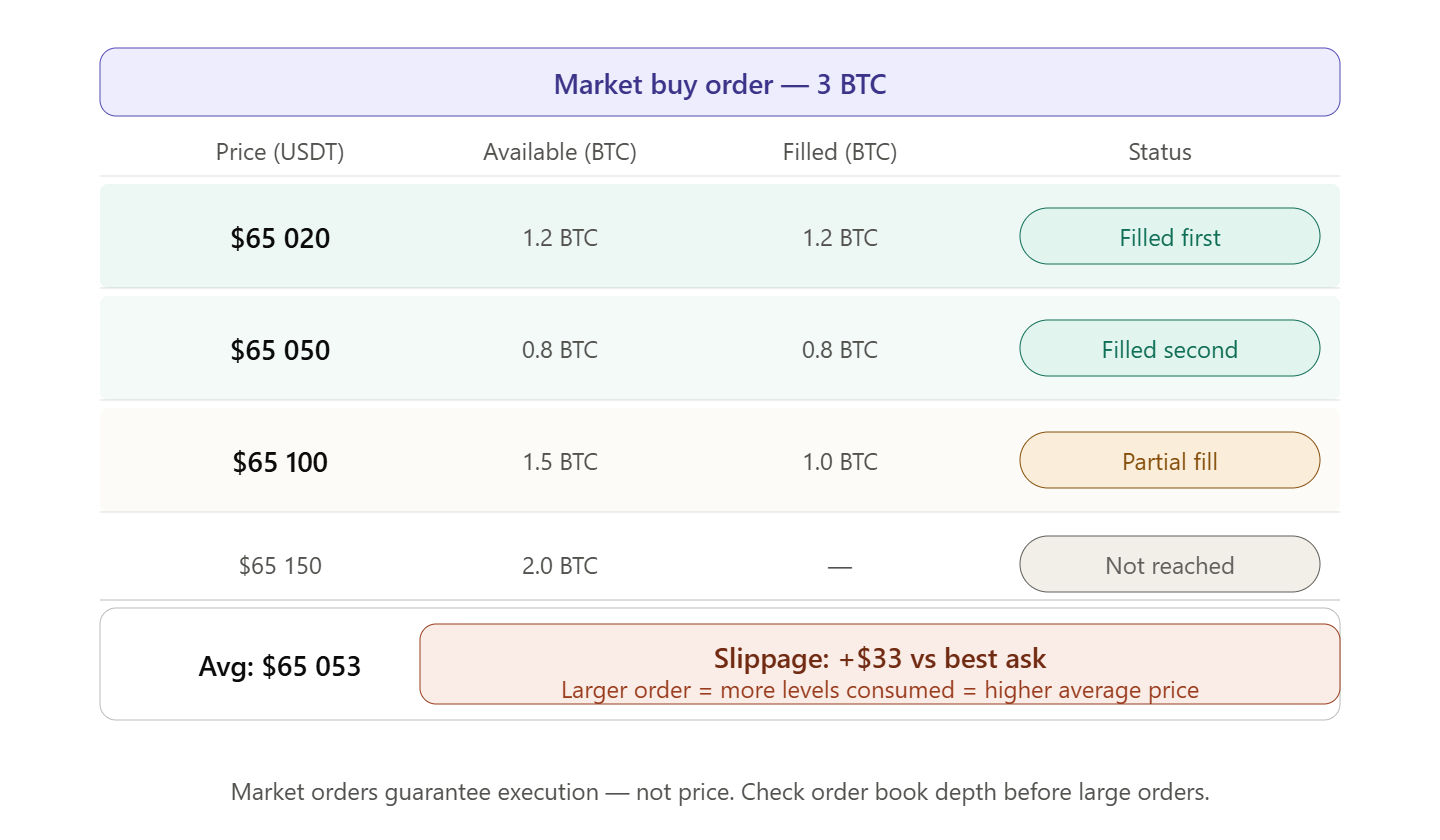
Example: Market Order to Buy 3 BTC
Current ask side of the order book:
| Price (USDT) | Volume (BTC) | Status |
|---|---|---|
| $65,020 | 1.2 BTC | Filled first |
| $65,050 | 0.8 BTC | Filled second |
| $65,100 | 1.5 BTC | Filled third (partially: 1 BTC) |
| $65,150 | 2.0 BTC | Not touched |
As a result, the purchase of 3 BTC is executed at three different prices. The average purchase price is therefore higher than $65,020.
Slippage
Slippage is the difference between the best available price when an order is submitted and the actual average execution price. It occurs when the order size exceeds the available volume at the best price level, causing the order to consume multiple levels of the order book.
| Factor | Effect on Slippage |
|---|---|
| Large order size | Increases |
| Low market liquidity | Increases |
| High volatility | Increases |
| Deep order book with a narrow spread | Decreases |
| Small order size | Decreases |
⚠️ Slippage on Low-Liquidity Markets
On low-liquidity trading pairs or when placing large orders, slippage on a market order can amount to several percent of the total trade value. Always check the order book depth before submitting a large market order.
Market Order vs. Limit Order
| Parameter | Market Order | Limit Order |
|---|---|---|
| Execution Guarantee | Yes | No |
| Price Guarantee | No | Yes |
| Execution Speed | Instant | Waits for the market |
| Slippage | Possible | None |
| Order Book Role | Taker | Maker |
| Trading Fee | Higher (Taker) | Lower (Maker) |
| Best Used When | Speed is critical | Price precision is important |
When to Use a Market Order
Best Use Cases
Urgent Position Exit. If the market is moving against you and you need to close your position immediately, a market order ensures instant execution without waiting in the order book.
Entering a Fast-Moving Market. If an asset has just broken through a key level and you want immediate exposure before the move continues, a market order guarantees participation.
Trading Highly Liquid Pairs with Small Position Sizes. On pairs such as BTC/USDT or ETH/USDT, slippage is typically minimal for small orders, making a market order nearly identical to executing at the best available price.
Executing a Stop-Loss. When it is essential to exit a position as soon as a stop level is reached, a stop-market order ensures execution regardless of market conditions.
When a Market Order Is Not Appropriate
- On low-liquidity trading pairs with wide spreads
- When trading large positions relative to the pair's daily trading volume
- When even a small price difference significantly affects trade profitability
- During periods of extreme volatility, when slippage may become unpredictable
💡 Pro Tip
Before submitting a large market order, open the order book and review the Total column on the ask side (for buy orders). Find the price level where the cumulative volume matches your order size. The difference between that price and the current best ask is your estimated slippage.
Market Orders in Cryptocurrency Markets
24/7 Trading and Liquidity Gaps
Cryptocurrency markets operate 24/7, but liquidity is not evenly distributed throughout the day. During off-peak hours in the major trading regions (Asia, Europe, and North America), liquidity tends to decline, increasing the likelihood of slippage on market orders.
Volatility and Rapid Price Movements
During sharp price movements caused by major news events or liquidation cascades, the order book may temporarily become much thinner as market makers withdraw liquidity. Under these conditions, even relatively small market orders can experience significant slippage.
Slippage Protection on Cifra X
On Cifra X, market orders are protected by a built-in Price Protection mechanism. If the execution price deviates from the expected market price beyond a predefined threshold, the order is rejected and returned to the user with a notification. This helps protect traders from excessive slippage during extreme market conditions.
How to Place a Market Order on Cifra X
- Select a trading pair in the Trading section.
- Open the order form and choose the Market tab.
- Enter the order size—either the amount of the base asset or the value in the quote currency.
- Click Buy or Sell. The order is executed immediately.
- Review the result in the Order History, where the final execution price and trading fee are displayed.
ℹ️ Market Order Price Display
The market order form on Cifra X displays an estimated execution price based on current market conditions. The actual execution price may differ slightly, especially for large orders or during periods of high volatility. The exact execution price is shown in your trade history after the order has been filled.
Market Orders and Taker Fees
A market order always acts as a taker because it removes existing liquidity from the order book rather than adding new liquidity. As a result, most exchanges charge the taker fee, which is generally higher than the maker fee.
| Role | Order Type | Fee |
|---|---|---|
| Taker | Market Order | Higher |
| Maker | Limit Order | Lower |
Partial Execution of a Market Order
In rare cases, a market order may be partially filled if there is insufficient liquidity in the order book to satisfy the entire order size. This is extremely uncommon for highly liquid pairs such as BTC/USDT or ETH/USDT, but it can occur on low-liquidity markets.
When a market order is partially executed, the filled portion is recorded as a completed trade. The remaining quantity is either cancelled (depending on the platform's execution rules) or converted into a limit order at the last executed price.
⚠️ Risk Warning
During periods of low liquidity or extreme market volatility, a market order may be executed at a price significantly worse than expected. There have been cases in cryptocurrency markets where market orders on thin order books were filled at prices dozens of percent away from the quoted market price. Always evaluate market liquidity before submitting a large market order.