What Is Bitcoin?
Bitcoin (BTC) is the first and most valuable decentralized cryptocurrency by market capitalization, created in 2009 by an anonymous author using the pseudonym Satoshi Nakamoto. Bitcoin was the world's first successful solution to the double-spending problem in digital payment systems without relying on a trusted intermediary such as a bank or payment processor.
The Bitcoin network has operated continuously since January 2009 and, as of 2025, remains the largest cryptocurrency by market capitalization. Over the years, Bitcoin has evolved from a niche experiment into an institutional-grade asset, recognized as legal tender in certain countries and included in the portfolios of major investment funds.
How Bitcoin Works
Core Mechanism
Bitcoin operates on its own blockchain using the Proof of Work (PoW) consensus mechanism. Transactions are grouped into blocks, which miners add to the blockchain approximately every 10 minutes by expending computational power to solve a cryptographic puzzle.
The entire transaction ledger is public and can be independently verified by anyone through blockchain explorers.
Key Technical Parameters
| Parameter | Value |
|---|---|
| Maximum Supply | 21,000,000 BTC |
| Circulating Supply (June 2025) | ~19.7 million BTC (~93.8%) |
| Block Time | ~10 minutes |
| Throughput | ~7 transactions per second |
| Hashing Algorithm | SHA-256 |
| Consensus Mechanism | Proof of Work |
| Divisibility | 1 BTC = 100,000,000 satoshis |
| Launch Date | January 3, 2009 |
Issuance and Halving
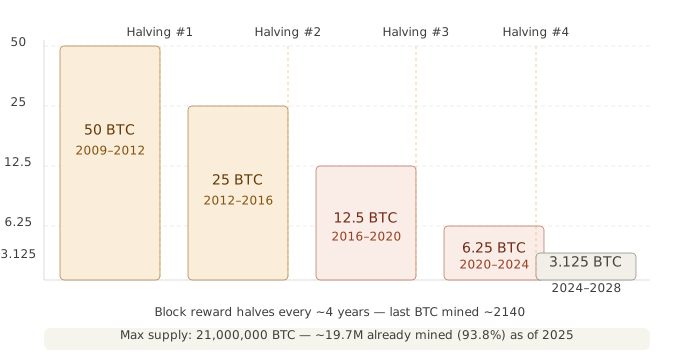
New BTC enter circulation exclusively through mining as a reward for adding new blocks to the blockchain. This reward is reduced by half every 210,000 blocks (approximately every four years) in an event known as a halving.
| Period | Block Reward | Halving Date |
|---|---|---|
| 2009–2012 | 50 BTC | — |
| 2012–2016 | 25 BTC | November 2012 |
| 2016–2020 | 12.5 BTC | July 2016 |
| 2020–2024 | 6.25 BTC | May 2020 |
| 2024–2028 | 3.125 BTC | April 2024 |
| 2028–2032 | 1.5625 BTC | ~2028 (estimated) |
ℹ️ Fixed Supply
The last Bitcoin is expected to be mined around 2140. After that, miners will earn revenue solely from transaction fees.
Addresses, Wallets, and Transactions
Types of Bitcoin Addresses
Several address standards have emerged throughout Bitcoin’s history and continue to coexist today:
| Type | Prefix | Standard | Features |
|---|---|---|---|
| Legacy | 1... | P2PKH | Original format with the broadest compatibility |
| Script | 3... | P2SH | Supports multisignature wallets and advanced scripts |
| Native SegWit | bc1q... | Bech32 | Lower fees, recommended format |
| Taproot | bc1p... | Bech32m | Improved privacy and efficiency |
💡 Helpful Tip
When withdrawing BTC from Cifra X, it is recommended to use Native SegWit (bc1q) addresses, as they provide the lowest network fees. Addresses starting with 1... and 3... are also supported and fully compatible.
How Transaction Fees Are Calculated
Bitcoin transaction fees are not fixed. They are market-driven and depend on:
- Mempool congestion — the number of pending transactions
- Transaction size in bytes — the number of inputs and outputs
- Desired confirmation speed
The fee rate is measured in sat/vByte (satoshis per virtual byte). The higher the fee rate, the faster the transaction is likely to be included in a block.
| Priority | Fee Rate (Typical) | Confirmation Time |
|---|---|---|
| High | 50–200+ sat/vB | Next block (~10 min) |
| Medium | 10–50 sat/vB | 1–3 blocks (~30 min) |
| Low | 1–10 sat/vB | 6+ blocks (1+ hour) |
Current fee estimates: mempool.space
⚠️Important
Fees can increase dramatically during periods of high network activity. Transactions with low fees may remain unconfirmed for several hours or even days.
Bitcoin as an Asset
Digital Gold
Bitcoin is often referred to as "digital gold" due to several similar characteristics:
| Property | Gold | Bitcoin |
|---|---|---|
| Limited Supply | ~215,000 tonnes in Earth's crust | 21 million BTC |
| Divisibility | Technically difficult | Up to 8 decimal places (satoshis) |
| Portability | Low | High |
| Verifiability | Requires specialized equipment | Mathematically verifiable |
| Resistance to Confiscation | Low | High (with self-custody) |
Institutional Adoption
As of 2025, Bitcoin has achieved significant institutional adoption:
- Bitcoin ETFs — in January 2024, the SEC approved the first spot Bitcoin ETFs in the United States, including BlackRock's IBIT and Fidelity's FBTC
- Corporate Reserves — several public companies, including MicroStrategy and Tesla, hold BTC on their balance sheets
- National Adoption — El Salvador (since 2021) and the Central African Republic have recognized BTC as legal tender
- U.S. Strategic Bitcoin Reserve — in March 2025, President Trump signed an executive order establishing a Strategic Bitcoin Reserve
Lightning Network
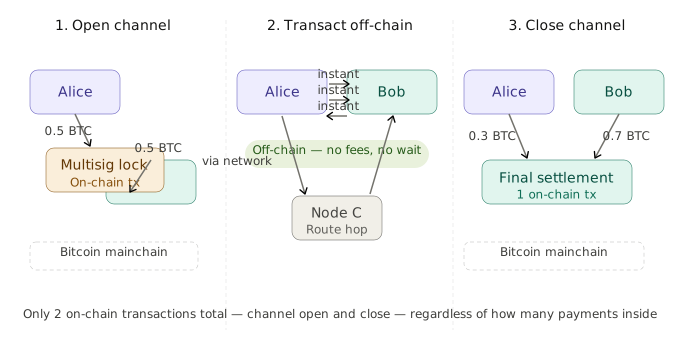
Lightning Network is a Layer 2 protocol built on top of Bitcoin to address scalability limitations. It enables near-instant, low-cost transactions without recording every payment on the main blockchain.
How it works:
- Two participants open a payment channel by locking BTC into a multisignature address.
- Within the channel, they can exchange transactions instantly and without on-chain fees.
- When the channel is closed, the final balance is settled and recorded on the Bitcoin blockchain.
| Parameter | Main Network | Lightning Network |
|---|---|---|
| Speed | ~10 minutes | Instant |
| Fee | Market-based (sat/vB) | Fractions of a satoshi |
| Security | Maximum | High |
| Use Case | Large transfers | Micropayments, retail payments |
Bitcoin Mining
Mining is the process of adding new blocks to the blockchain by repeatedly computing the hash of a block header. The miner who first discovers a valid hash receives a reward consisting of the block reward and transaction fees.
Network Difficulty
The protocol automatically adjusts difficulty every 2,016 blocks (approximately every two weeks) to ensure that the average block time remains close to 10 minutes regardless of the network's total hash power.
ℹ️ Hash Rate
Hash rate is the combined computational power of all miners participating in the network. As of 2025, Bitcoin's hash rate exceeds 800 EH/s (exahashes per second), reaching all-time highs.
Mining Pools
Due to intense competition, solo mining is generally unprofitable. Miners join mining pools, where participants collectively mine blocks and share rewards proportionally based on their contributed computing power.
⚠️ Concentration Risk
The concentration of hash power among a small number of large mining pools remains a topic of discussion regarding the degree of decentralization within the Bitcoin network.
Bitcoin Storage
Storage Types
| Type | Key Control | Risks | Examples |
|---|---|---|---|
| Custodial (Exchange) | Exchange controls the keys | Exchange hacks, account restrictions | Cifra X, Binance |
| Hot Wallet | User controls the keys | Malware, phishing attacks | Electrum, BlueWallet |
| Cold Wallet | User controls the keys | Physical loss of the device | Ledger, Trezor |
| Paper Wallet | User controls the keys | Physical destruction or loss | Printed private key |
"Not your keys, not your coins": when BTC is stored on an exchange, the exchange technically controls the assets. For long-term storage of significant amounts, self-custody using a hardware wallet is generally recommended.
Advantages and Risks
Advantages
- Decentralization — no single organization controls the network
- Deflationary Monetary Model — fixed supply protects against inflationary dilution
- Liquidity — the highest trading liquidity among all crypto assets
- Network Effect — the largest and most battle-tested cryptocurrency network
- Transparency — all transactions can be publicly verified
- Censorship Resistance — transactions cannot be centrally blocked
Risks
⚠️ Risk Warning
Bitcoin is a highly volatile asset. Historically, BTC has experienced price declines of 70–85% during bear markets. Only invest funds that you can afford to lose.
- High Volatility — significant short-term price fluctuations
- Regulatory Risk — legal and regulatory changes may restrict usage
- Transaction Irreversibility — mistaken transfers cannot be reversed
- Scalability Limitations — the base layer is limited to approximately 7 TPS
- Quantum Computing — a potential long-term threat to elliptic curve cryptography
💡 Helpful Tip
Before purchasing Bitcoin for the first time, it is recommended to understand the fundamentals of secure storage: how a seed phrase works, the difference between hot and cold wallets, and when self-custody may be appropriate. These topics are covered in detail in the Cifra X Wiki's Security section.