What Is Liquidity
Liquidity is the ability of an asset to be bought or sold quickly at a price close to the current market price without significantly affecting that price. The easier it is to execute a trade without causing a substantial price change, the higher the asset's liquidity.
In the cryptocurrency market, liquidity determines the quality of the trading environment: how easily traders can enter and exit positions, how fair execution prices are, and how stable an asset remains when large trades are placed. Liquidity is one of the most important factors when selecting an asset and assessing trading risk.
Types of Liquidity
Market Liquidity
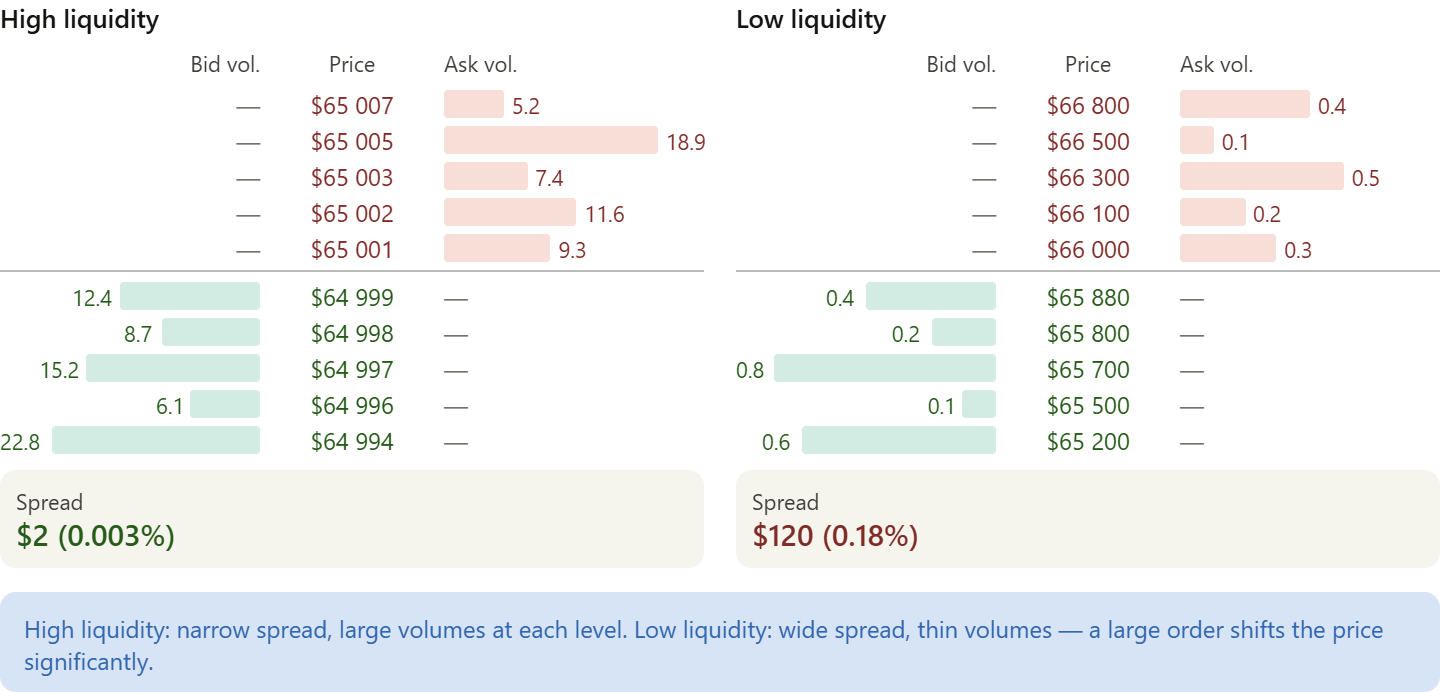
Market liquidity describes how easily an asset can be traded on a particular market. A highly liquid market typically has:
- A narrow spread between the bid and ask prices.
- Large order book depth across multiple price levels.
- High 24-hour trading volume.
- Stable prices even when executing large orders.
Funding Liquidity
Funding liquidity refers to the availability of borrowed capital in the market. It affects traders' ability to open margin positions and influences funding rates in futures markets.
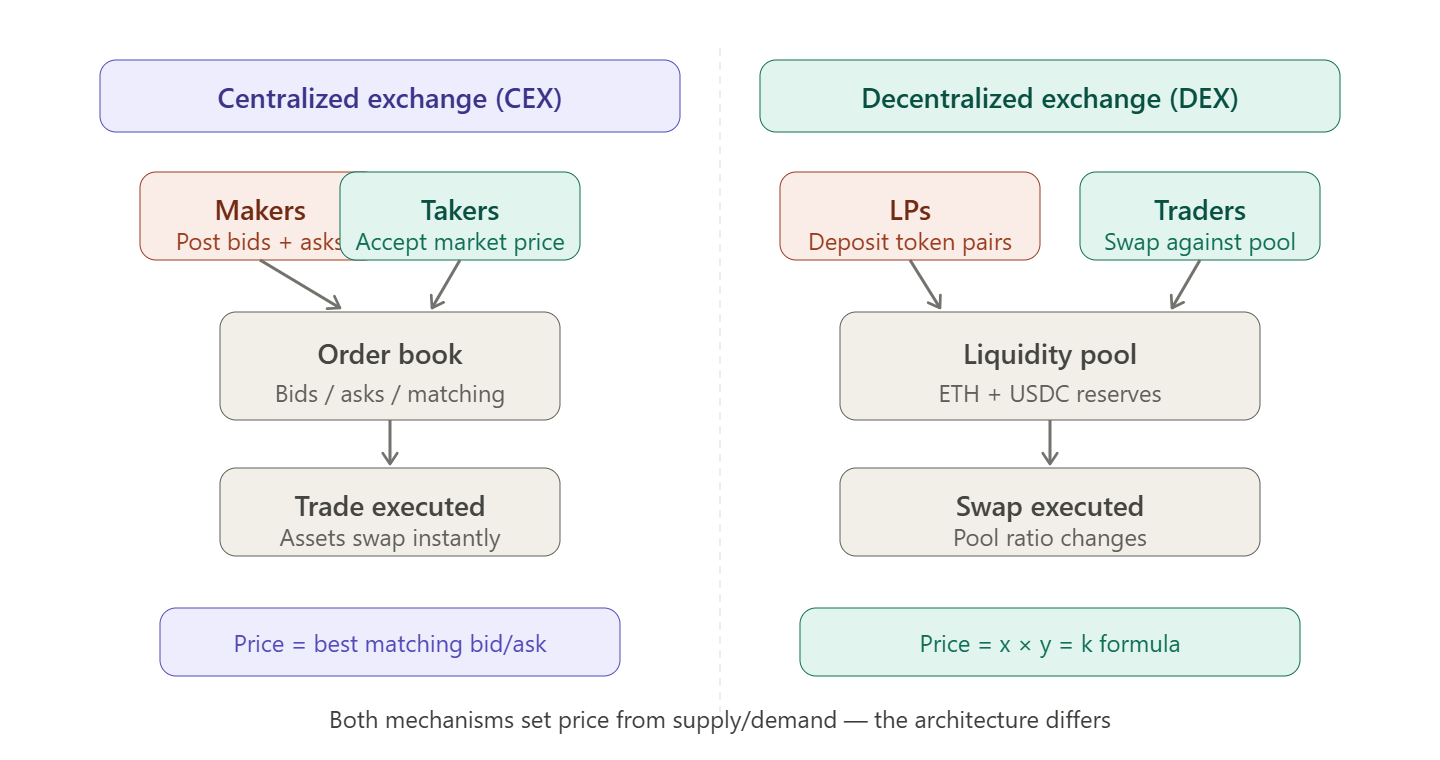
Liquidity Pool (DeFi)
On decentralized exchanges, liquidity pool liquidity is the total value of assets supplied by liquidity providers to an AMM pool. The larger the pool, the lower the slippage during swaps.
How Liquidity Is Measured
Liquidity is a multidimensional concept, and no single metric can fully describe it.
| Metric | What It Measures | Interpretation |
|---|---|---|
| Bid-Ask Spread | Difference between the best bid and ask prices | Narrower spread = higher liquidity |
| 24h Trading Volume | Total trading volume over 24 hours | Higher volume = higher liquidity |
| Order Book Depth | Volume of orders within ±2% of the current price | More depth = lower slippage |
| Slippage | Difference between expected and actual execution price | Lower is better |
| TVL (DeFi) | Total value locked in a liquidity pool | Higher TVL = lower DEX slippage |
| Market Impact | Price change caused by an order of a given size | Lower impact = higher liquidity |
Factors That Affect Liquidity
Market Capitalization and Popularity
Bitcoin and Ethereum have the highest liquidity because they benefit from the largest trading volumes, institutional market makers, and well-developed derivatives markets. Smaller-cap altcoins, by contrast, often suffer from fragmented and limited liquidity.
Number of Trading Venues
The more exchanges an asset is listed on, the greater its overall liquidity. Arbitrage traders who align prices across exchanges also contribute to the ecosystem's liquidity.
Time of Day and Market Sentiment
Liquidity is not constant. It typically decreases:
- During off-peak trading hours in Asian or U.S. markets.
- On weekends and public holidays.
- During periods of market panic, when market makers withdraw orders from the order book.
Market Makers
Market makers are companies or automated trading systems that continuously place both bid and ask orders, earning the spread as compensation. Their presence is critical for maintaining liquidity. Without market makers, spreads widen and executing large orders becomes much more difficult.
ℹ️ Market Makers on Cifra X
Cifra X works with professional market makers to maintain tight spreads and deep order books across major trading pairs. This enables traders to execute orders at fair market prices, even for relatively large trade sizes.
Slippage: The Main Consequence of Low Liquidity
Slippage is the difference between the expected execution price of an order and the actual execution price. It occurs when the order size exceeds the available liquidity at a particular price level, causing the trade to consume multiple levels of the order book.
Slippage Example
Imagine the following sell-side order book:
| Price | Volume (BTC) |
|---|---|
| $65,000 | 0.5 BTC |
| $65,050 | 0.3 BTC |
| $65,150 | 0.8 BTC |
| $65,300 | 1.2 BTC |
If you place a market buy order for 2 BTC, the order will be executed across all four price levels. The average execution price will be higher than $65,000—this difference is called slippage.
⚠️ Slippage on DeFi Platforms
On decentralized exchanges using AMM mechanisms, slippage can be significantly higher than on centralized exchanges. Always review the estimated slippage before confirming a swap, especially in pools with a low TVL.
Comparing Liquidity Across Assets
| Asset | Typical Daily Volume | Typical Spread | Liquidity |
|---|---|---|---|
| BTC/USDT | $20–30B | 0.01–0.05% | Very High |
| ETH/USDT | $8–15B | 0.01–0.05% | Very High |
| SOL/USDT | $2–5B | 0.05–0.1% | High |
| Top-20 Altcoins | $100–500M | 0.1–0.3% | Medium |
| Small-Cap Altcoins | $1–20M | 0.5–2%+ | Low |
| New Tokens | <$1M | 2–10%+ | Very Low |
These values are approximate and may vary significantly depending on market conditions.
Liquidity and Trading Strategy
An asset's liquidity directly influences trading strategy and risk management.
Highly Liquid Assets (BTC, ETH)
- Suitable for large positions due to minimal slippage.
- Ideal for scalping and high-frequency trading because of tight spreads.
- Allow traders to exit positions quickly at almost any time.
- Less vulnerable to price manipulation.
Low-Liquidity Assets (Small-Cap Altcoins)
- Require smaller position sizes relative to daily trading volume.
- Carry a higher risk of being unable to exit quickly without moving the market.
- Can experience sharp price swings even with relatively small trades.
- Are more susceptible to pump-and-dump schemes.
💡 Helpful Tip
A practical rule of thumb is that your position size should not exceed 1–2% of an asset's daily trading volume. For example, if you want to buy $50,000 worth of a token with a daily trading volume of $200,000, your order would represent 25% of the daily volume and would almost certainly result in significant slippage.
Liquidity Crisis
A liquidity crisis occurs when market liquidity suddenly dries up, spreads widen dramatically, and large orders trigger extreme price movements. In the cryptocurrency market, this can happen during:
- Large liquidation cascades in futures markets.
- Major negative events such as exchange hacks or regulatory crackdowns.
- Stablecoin bank runs or depegging events.
- Severe disruptions in the global economy.
During these periods, market makers often withdraw their orders, order book depth collapses, and prices can move by dozens of percent within minutes.
⚠️ Warning
During a liquidity crisis, market orders may be executed at prices far worse than expected. While limit orders do not guarantee execution, they provide protection against catastrophic slippage.
Liquidity in DeFi
Liquidity in decentralized finance works fundamentally differently from liquidity on centralized exchanges.
AMMs and Liquidity Pools
Instead of using an order book, Automated Market Makers (AMMs) such as Uniswap and Curve use mathematical formulas to determine prices. In Uniswap v2, pricing is based on the formula:
x × y = k (Uniswap v2 constant product formula)
The larger the pool's Total Value Locked (TVL), the lower the slippage during swaps.
Concentrated Liquidity (Uniswap v3)
Uniswap v3 allows liquidity providers to concentrate their liquidity within a selected price range, significantly improving capital efficiency. Liquidity is much deeper within the active price range and drops to zero outside of it.