What Is Spot Trading
Spot trading is the purchase or sale of an asset at the current market price with immediate settlement. The term "spot" comes from the English expression on the spot, meaning "here and now": the buyer receives the asset immediately, and the seller receives payment immediately.
The spot market is the foundation of every exchange. It is where the real market price of an asset is formed through live supply and demand. Unlike futures or options, a spot trade does not involve delayed settlement, leverage, or future obligations—you buy and own the asset immediately.
How Spot Trading Works
Basic Mechanism
In a spot transaction, one asset is directly exchanged for another. For example, if you buy 1 ETH for 3,000 USDT, 3,000 USDT is deducted from your balance, and 1 ETH is credited to your account. The trade is executed immediately.
The price of a spot trade is determined by the order book—a list of buy and sell orders. When a buyer's order matches a seller's order at a compatible price, the trade is executed through a process called matching.
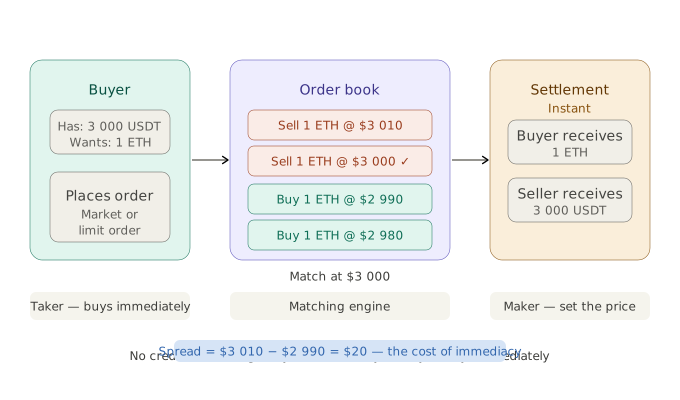
Participants in a Trade
| Role | Action | Order Type |
|---|---|---|
| Taker | Accepts an existing price from the order book | Market order |
| Maker | Places an order and waits for execution | Limit order |
A taker executes a trade immediately at the best available market price. Takers remove liquidity from the order book.
A maker places an order at a specified price and waits for another trader to accept it. Makers add liquidity to the order book.
ℹ️ Maker and Taker Fees
On most exchanges, makers pay lower trading fees than takers because they provide liquidity to the market. Current trading fees on Cifra X are available in the Fees section.
Spot Order Types
Market Order
A market order is executed immediately at the best available price in the order book. It guarantees execution but does not guarantee the exact execution price, especially in markets with low liquidity or for large orders.
When to use: when execution speed is more important than price precision.
⚠️ Slippage
Large market orders or low market liquidity may result in slippage—the actual execution price may be worse than expected. A large market order can consume multiple price levels in the order book.
Limit Order
A limit order is executed only at the specified price or a better one. The order remains in the order book until it is executed or canceled.
When to use: when you need precise control over your entry or exit price.
Example: Bitcoin is trading at $65,000. You place a limit buy order at $63,000. The order will only be executed if the market price falls to $63,000 or below.
Stop-Limit Order
A stop-limit order combines a stop trigger with a limit order. Once the stop price is reached, a limit order is automatically placed in the order book at the specified limit price.
When to use: to automatically protect a position or enter the market after a breakout.
Stop-Market Order
When the stop price is reached, a market order is executed. It guarantees execution but does not guarantee the execution price.
When to use: for reliable loss protection (stop-loss).
Order Type Comparison
| Order Type | Execution Guaranteed | Price Guaranteed | Speed |
|---|---|---|---|
| Market | Yes | No | Instant |
| Limit | No | Yes | Waits for execution |
| Stop-limit | No | Yes | After trigger |
| Stop-market | Yes | No | After trigger |
Spot Trading vs Other Types of Trading
Understanding the differences between spot trading and other trading instruments is essential for proper risk management.
| Feature | Spot | Futures | Margin Trading |
|---|---|---|---|
| Asset Ownership | Yes, immediately | No (contract only) | Yes, using borrowed funds |
| Leverage | No (1x) | Up to 125x | Up to 10x (spot margin) |
| Liquidation Risk | No | Yes | Yes |
| Settlement | Immediate | Future date / Perpetual | Immediate |
| Complexity | Low | High | Medium |
| Financing Costs | None | Funding rate | Interest on borrowed funds |
⚠️ Risk Warning
Futures and margin trading carry the risk of liquidation, meaning you may lose your entire collateral. Beginners are strongly advised to start with spot trading without using leverage.
Key Spot Trading Concepts
Spread
The spread is the difference between the best ask price and the best bid price in the order book.
Best bid: $64,980
Best ask: $65,020
Spread: $40 (≈ 0.06%)
A narrow spread indicates high liquidity. A wide spread usually signals lower liquidity or higher market volatility.
Market Depth
Market depth represents the volume of buy and sell orders available at different price levels in the order book. A deep market can absorb large orders without causing significant price movements.
Slippage
Slippage is the difference between the expected execution price and the actual execution price. It commonly occurs with market orders during periods of low liquidity or when placing large orders.
Trading Pair
Spot trading is always performed within a trading pair—two assets exchanged against each other. Learn more in the article What Is a Trading Pair.
The Cifra X Spot Trading Interface
The Cifra X spot trading interface includes the following components:
| Component | Purpose |
|---|---|
| Price Chart | Displays price movements (candlesticks or line chart) |
| Order Book | Shows active buy and sell orders |
| Order Form | Create market, limit, and stop orders |
| Open Orders | Displays your active orders |
| Order History | Shows your completed trades |
Step-by-Step Spot Trading Process
- Choose a trading pair — for example, BTC/USDT.
- Review the current price and order book — evaluate the spread and market depth.
- Select an order type — Market (instant) or Limit (at a specified price).
- Enter the order size — specify the asset amount or quote currency value.
- Review the order details — check the estimated execution price and total amount.
- Confirm the order — the required funds will be reserved in your account.
- Order executed — the purchased asset is credited to your balance.
💡 Helpful Tip
For your first trades, consider using limit orders. They give you full control over the execution price and allow you to trade without rushing. Market orders are generally more suitable for experienced traders when execution speed is the top priority.