What Is an NFT
An NFT (Non-Fungible Token) is a cryptographic token recorded on a blockchain that represents unique ownership of a specific digital or physical asset. Unlike standard tokens such as ETH or USDT, where every unit is interchangeable, each NFT is unique or issued in a strictly limited quantity, as defined by its smart contract.
The term non-fungible means not interchangeable. Two NFTs from the same collection are not equivalent, just as two different plots of land are not identical—even if they have the same market value. NFT technology introduced the concept of verifiable digital ownership. Before NFTs, digital files could be copied indefinitely without any reliable way to identify the original owner.
Fungibility: What's the Difference?
Understanding NFTs starts with understanding fungibility.
| Asset Type | Fungible? | Example |
|---|---|---|
| Fiat currency | Yes | Any two $100 bills have the same value |
| Cryptocurrency | Yes | 1 BTC = 1 BTC, every coin is identical |
| Stocks | Yes | One Apple share is identical to any other Apple share |
| Land | No | No two plots of land are exactly the same |
| Artwork | No | The Mona Lisa is one of a kind |
| NFT | No | Every token has a unique identifier |
How NFTs Work
Smart Contracts and Metadata
An NFT exists as a record within a blockchain smart contract. Each token has a unique Token ID, which distinguishes it from every other token created by the same contract.
Rather than storing the actual file, an NFT stores metadata describing the asset.
{
  "name": "CryptoPunk #3100",
  "description": "One of 10,000 unique collectible characters",
  "image": "ipfs://QmXq...7g2",
  "attributes": [
    { "trait_type": "Type", "value": "Alien" },
    { "trait_type": "Accessory", "value": "Headband" }
  ]
}
The metadata contains a link to the image or other media, typically stored on IPFS (a decentralized storage network) or on a traditional web server. This is an important distinction: in most cases, the file itself is not stored on the blockchain—only a reference to it.
⚠️ Risk of Centralized Storage
If an NFT's metadata points to a centralized server instead of decentralized storage such as IPFS or Arweave, and that server goes offline, the image or file may become unavailable. The NFT itself will remain on the blockchain, but its content may no longer be accessible. Always check where an NFT's metadata is stored before purchasing it.
Token Standards
| Standard | Network | Type | Description |
|---|---|---|---|
| ERC-721 | Ethereum | Unique NFT | The original standard for unique NFTs |
| ERC-1155 | Ethereum | Multi-token | Supports both fungible and non-fungible tokens in one contract |
| SPL | Solana | NFT | Solana token standard used for NFTs |
| FA2 | Tezos | Multi-token | Tezos standard supporting NFTs and fungible tokens |
NFT Lifecycle
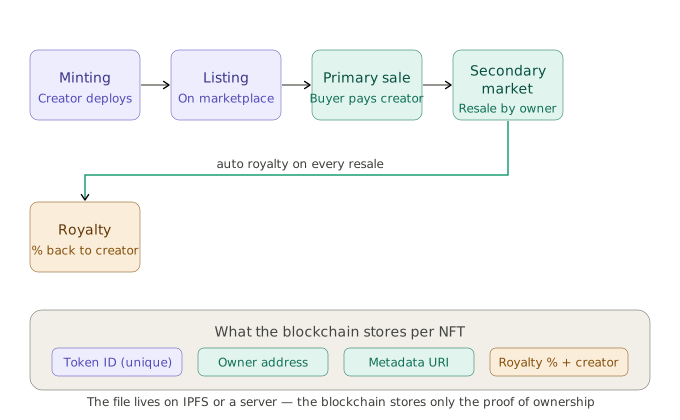
- Minting — The NFT is created. The creator deploys a smart contract or uses an existing one, the token is recorded on the blockchain, and ownership is assigned to the creator's wallet.
- Listing — The owner lists the NFT for sale on an NFT marketplace.
- Sale — The buyer completes the purchase, and the smart contract automatically transfers ownership of the NFT.
- Secondary Market — The new owner can sell, transfer, gift, or use the NFT in supported applications.
- Royalties — If specified in the smart contract, the original creator automatically receives a royalty each time the NFT is resold.
Where NFTs Are Stored
NFTs are stored at your wallet address on the blockchain, just like regular tokens. You can view your NFTs using:
- NFT-compatible wallets (MetaMask, Phantom, Rainbow)
- NFT marketplaces (OpenSea, Blur, Magic Eden)
- Blockchain explorers (Etherscan — NFT tab)
NFT Use Cases
Digital art and collectibles are only one application of NFT technology. The range of real-world use cases is much broader.
Digital Art and Collectibles
The first and most widely recognized use case. Artists mint their works as NFTs, allowing buyers to obtain verifiable ownership of the original. Examples include CryptoPunks, Bored Ape Yacht Club, and Art Blocks.
Gaming Assets (GameFi)
In-game items, characters, and virtual land represented as NFTs, enabling players to trade them outside the game and, in some cases, use them across compatible games.
Examples: Axie Infinity, Gods Unchained, Illuvium
Tickets and Memberships
NFTs can serve as event tickets or membership cards. Smart contracts automatically verify ownership, prevent counterfeiting, and enable secondary-market transfers.
Examples: GET Protocol, YellowHeart, and numerous NFT communities
Music and Media
Musicians can release songs or albums as NFTs, allowing royalty rights to be distributed among token holders.
Examples: Royal, Sound.xyz, Catalog
Tokenization of Real-World Assets (RWA)
NFTs can represent legally linked ownership of physical assets such as real estate, vehicles, and luxury goods.
Digital Identity and Credentials
Verified certificates, diplomas, and achievement badges can be issued as NFTs, making them tamper-resistant and easy to verify.
Domain Names
ENS domains (.eth) and similar blockchain domains are NFTs—they are unique, transferable, and fully owned by the holder.
Key NFT Market Metrics and Terms
| Term | Meaning |
|---|---|
| Floor Price | The lowest price at which an NFT from a collection is listed for sale |
| Volume | Total trading volume of a collection over a given period |
| Holder Distribution | Distribution of NFTs among holders; high concentration may indicate increased risk |
| Rarity | How uncommon a specific NFT's attribute combination is within a collection |
| Mint Price | The original purchase price during the mint |
| Royalty | A percentage of secondary sales automatically paid to the creator |
| Sweep | Buying multiple NFTs at the floor price to accumulate a position |
| Paper Hands / Diamond Hands | Selling quickly during a price decline / holding despite market volatility |
Major NFT Marketplaces
| Marketplace | Blockchain | Key Feature |
|---|---|---|
| OpenSea | Ethereum, Polygon, Solana | Largest multi-chain NFT marketplace by trading volume |
| Blur | Ethereum | Designed for professional traders with aggregation features |
| Magic Eden | Solana, Ethereum, Bitcoin | Leading marketplace for Solana NFTs |
| Tensor | Solana | Professional trading platform for Solana NFTs |
| Foundation | Ethereum | Curated digital art marketplace |
| Objkt | Tezos | Leading Tezos NFT marketplace with low transaction fees |
NFTs on Bitcoin: Ordinals
In 2023, the Ordinals protocol introduced the ability to inscribe arbitrary data directly onto individual satoshis on the Bitcoin blockchain. This created NFT-like digital assets on Bitcoin without relying on smart contracts, offering the security of the Bitcoin network while providing more limited programmability.
Benefits and Risks
Benefits
- Verifiable ownership — Ownership is recorded on the blockchain without relying on a trusted intermediary.
- Programmable royalties — Creators can automatically receive royalties from every secondary sale.
- Liquidity for digital assets — Digital items that were previously locked within a single platform can now be traded.
- Transparency — Ownership history and all transactions are publicly verifiable.
- New monetization models — NFTs create new revenue opportunities for artists, musicians, and content creators.
Risks
⚠️ Risk warning
The NFT market is highly volatile. Most NFT collections lose a significant portion of their value after the initial hype. Liquidity in the secondary market is not guaranteed, and you may be unable to sell an NFT at a reasonable price.
- High volatility — An NFT's value may fall to zero if interest in the collection disappears.
- Low liquidity — Unlike fungible tokens, NFTs are often difficult to sell quickly at a fair market price.
- Metadata storage risk — If the server hosting the metadata becomes unavailable, the NFT may become an empty reference.
- Fraud and scams — Fake collections, phishing mint websites, and wash trading used to artificially inflate trading volume are common risks.
- Regulatory uncertainty — The legal status of NFTs as ownership instruments remains undefined in many jurisdictions.
- Gas fees — Minting and transferring NFTs requires paying blockchain network fees, which may be substantial.
🚨 Caution: Transaction Signatures
Many NFT thefts occur through malicious transaction signatures. Users connect their wallets to fraudulent websites and unknowingly sign transactions that transfer all of their NFTs to an attacker. Never sign transactions on unfamiliar websites without fully understanding what you are approving.
💡 Helpful Tip
Before purchasing any NFT, verify three things:
- the smart contract address matches the project's official contract;
- the metadata is stored on IPFS or Arweave rather than on a centralized server;
- the collection has a genuine trading history, not just a few suspiciously large recent transactions.